Se afișează postările cu eticheta Carte. Afișați toate postările

sâmbătă, 25 ianuarie 2025

Everyone deserves the chance to fly

WickedWicked by Gregory Maguire
My rating: 3 of 5 stars

Wicked the Musical is one of my favorites of the genre, and I really liked Wicked the movie. I've been wanting to read the book for years, but getting it as a gift last Christmas finally presented the opportunity.

From the off, finding out it's been written a few minutes away from my house made it endearing. But once the story gets going, the world we discover has little if anything to do with the world of the aforementioned visual mediums.

Gregory Maguire admits to creating a world much darker and much grittier than the one in the musical-turned-movie, and it takes a bit to accept it. The writing is beautiful though, especially in the beginning, and the time in Shiz is, in my opinion, the most successful part of the book.

There'll be spoilers ahead, so stop reading here if you don't want them.

The weird pornographic interlude in the middle is where the book goes astray, I feel. Fiyero has a much smaller part than I thought he would, he seems to exist merely to conceive Elphaba's son because after his death or presumed death, he is invoked a number of times but he cannot be held accountable for any course of affairs.

And I do feel that the second half of the book is weaker than the first. Every time jump makes Elphaba more inconsistent with herself, her behavior more erratic, the storyline in more need of reader's suspension of disbelief. Hence, when we finally get to merge its ending with the one from The Wizard of Oz, it doesn't click in nicely, it feels forced, and Elphaba is way out of character. In that sense, the musical has done a great job in leaving an open ending. Of course, the author has the excuse of all of the open possibilities in the half-decades that we skip, but these sudden turns make the story confusing, the message harder to decipher. It's all good and swell setting out to create a world, and in terms of world-creation the book is a monumental and admirable effort, but to what end? What do we do with the world, once created?

I suppose we'll see, Wicked is, at the end of the day, the first in a series of four, and in the great tradition of the Victorian novel, the next books will be concerned with future generations.

But if I'm completely honest, for all the expectation, Wicked left me a bit deflated and at the end of it I don't feel a desire to read book 2 of the series. I feel like taking another look at The Wizard of Oz.

*** Test of copying the HTML code from the Goodreads review. You can ignore it or you can...

View all my reviews

sâmbătă, 21 august 2021

Nebunii

Ioana Nicolaie - Pelinul Negru, Humanitas 2017

Pelinul Negru e povestea primilor ani de scoala ai Augustinei Bulta, o fata nascuta la cateva luni de la explozia centralei atomoelectrice din Cenobil. Augustina traieste in nordul Romaniei, intr-un oras de munte, probabil Sangeorzul nativ al Ioanei Nicolaie, dar citind romanul am recunoscut multe din cliseele copilariei mele, cliseele primilor ani de dupa comunism.

Insirate pe hartie, se citesc ca un lung pomelnic de barbarisme, de situatii specifice unui stat esuat si unei societati in paragina, lucruri pe care le-am vazut de aproape in copilaria mea, pe care nu le doresc nimanui si despre care sunt recunoscator ca am avut norocul istoric sa le depasim. Ce e interesant insa e ca am citit cartea destul de detasat emotional, recunoscand atat situatiile, cat si viata interioara a protagonistei, dar fara sa fiu prea miscat de ele. Pana aproape de ultimele pagini. Si cred talentul scriitoricesc al Ioanei Nicolaie e cel care m-a facut sa fiu atat de miscat de unul din cele mai banale evenimente ale Romaniei post-comuniste. Copilul speriat de taierea porcului e un tablou care a tot fost descris in literatura romana si un fapt despre care se poarta frecvent discutii la mai toate nivelele de varsta si profunzime. Un fapt care, descris intr-un roman, nu pare sa mai aiba suficienta seva artistica incat sa poata misca cititorul. Ei bine, sfarsitul Guitului familiei Bulta reuseste sa aiba acelasi efect sfasaietor ca despartirea autorului de Micul Print in romanul omonim.

Si asta e un mare compliment, Micul Print e cartea mea preferata. Dar da, periplul Augustinei prin lumea literelor care nu stau locului si prin societatea care incearca sa se regaseasca pe sine imbina elemente din Micul Print (de unde motivul prieteni vulpe e furat fara rusine si, am impresia, si fara justificare) si din Flori pentru Algernon. Augustina e un Charlie Gordon de Romania, fara norocul de a cunoaste performanta academica, dar cu speranta ca teritoriul nu-i este complet interzis.

Astept cu nerabdare sa citesc mai mult din... saga Rodnei? Trilogia familiei Bulta? Nu stiu cum sa-i spun, pentru ca Ioana Nicolaie nu i-a dat nici un titlu, si nici nu da vreo indicatie in ce fel romanele s-ar lega intre ele. Dar Cartea Reghinei si Tot Inainte sunt si ele pe lista mea, si o sa am un verdict mai clar asupra povestii familiei Bulta odata ce le citesc. Pana atunci, ma bucur sa gasesc in Augustina o protagonista feminina a literaturii romane, scrisa de o femeie si care nu se defineste in nici un fel prin raportarea la masculin, nu-si vede rolul in lume ca purtatoare de copii si obiect al placerii masculine. Suna banal, dar nu prea am reusit sa gasesc multe alte personaje asemenea in literatura romana. Sper ca mai sunt, in special in literatura romana recenta, si ca n-am reusit sa le gasesc pentru ca n-am citit eu suficient, nu pentru ca-s asa rare. S-ar putea face un caz pentru Vitoria Lipan si, intr-adevar, ea e prima oprire pentru cine cauta femei puternice in literatura romana, dar lumea in care se misca Vitoria e una a barbatilor. In lumea Augustinei barbatii exista, dar sunt o chestie cu care mai degraba nu vrei sa interactionezi. Si pe buna dreptate.

In rest, Ioana Nicolaie merge cu pedala lirica apasata tot timpul, uneori chiar prea tare. Povestea e spusa la persoana intai, iar ochii Augustinei sunt un filtru prin care cititorul primeste o lume diferita de experienta senzoriala cu care e obisnuit, o lume pe care trebuie s-o traduca inainte s-o inteleaga. Ceea ce e bine, efortul te tine angajat in poveste, iar faptul ca nici personajul, nici autoarea nu simt vreo obligatie de a explica tot ce se intampla face lumea romanului foarte reala. Augustina e dislexica sau doar usor intarziata? Cat de mult a afectat-o Cernobil? Cat de mult i-a afectat familia Cernobil? Putem sa intuim, putem sa ghicim, dar nu stim cu siguranta. Iar explicatii suplimentare nu ne datoreaza nimeni.

miercuri, 9 iunie 2021

Wrong side of the tracks

 Angela Carter - Wise Children, Vintage Books, 2006

Emma Rice's stage adaptation of Wise Children is the best scripted drama I have ever seen on a stage. So, once I found out the play is based on a book and that, furthermore, the book is actually quite a popular one, naturally, I wanted to read it.

I can fully see the appeal. Wise Children is expertly crafted literature, with a lot of show-stopping moments. Moments when you actually feel like stopping your reading just to contemplate the beauty of its prose. That is rare. I am curious about Angela Carter's other writing, although it's a safe assumption that the lady was a master of her craft. Yes, was. Life cut short. Died in 1992 at the age of 51. Lung cancer. Hey-ho.

While I was admiring the writing, however, oftentimes I have asked myself. Is this maybe a bit... over-written? Although over-written is probably not the best choice of words. 'Baroque' is what Ali Smith calls it in the 2006 introduction, and I can fully get on board with that.

The book is luxurious in detail and scarce in action. In fact, it doesn't even feel like a linear novel as much as a conglomerate of snapshots, a series of photos which, in quick succession, give the impression of movement. Sometimes there are large gaps. Sometimes one or the other of the tableaus gets lost in a different position than its natural place in the storyline. All without a warning, all without any particular regard for the effort it elicits from the reader. Because yes, beautiful as it is, it can be hard going. 'Heavy writing', I called it.

I suppose, in a way, it's exactly like listening to a stream of stories from an old lady that at times sound like digressions, at times like senseless blabber, but it's all so fascinating that not only you keep listening, you are actively engaged in trying to put everything in order. I'm pretty sure this was the intention.

The old lady in question is Dora Chance, twin sister of Nora and the protagonist of the book, born in 1915, but with a story that starts 2 generations previous and goes all the way towards the late years of the 20th century. All of it imagined, of course, but so vivid that it might as well be true. After all, who is to say that one cannot turn an invisible corner on Brixton Road, or Coldharbour Lane, and end up on Bard Road, the street where the Chance sisters live, but that cannot be found on a map?

This book is quintessentially British, quintessentially London. A certain part of London, of a certain time. Brixton looks a lot different now than in 1990 - everything changes. It's still 'the wrong side of the tracks' though - it has been since the days of Shakespeare! Because some things never change, isn't it?

Speaking of Shakespeare... yes, he is almost a character. So much in the book goes back to Shakespeare! And Carter creates a playful reverent/irreverent relationship with the Bard that I feel it should become representative for the way any culture looks upon its agreed-upon highly esteemed heroes. Yes, you can both admire Shakespeare and make fun of him. Nothing wrong with the cat using Shakespeare's open-top bust as a litter box. But why, oh, why, Angela, must you be looking for the ugliest, dirtiest, most reprehensible details of any single story. Why focus on the ugliest aspects of human nature?

Honest question, I don't understand. For instance, Charlie Chaplin, to this day one of the most venerated figures of South London. Do you know what Carter/Chance has to say about him? 'Hung like a horse'. Not even a bad thing per se, although surely he was known for more than that?

Dude asks Dora for an autograph? She can see the bits of sperm stuck in his mustache after blowing his boyfriend during the movie. All of it in good humor, sure, but was it really the most striking aspect about the fellow?

I hope you get the gist.

And finally, my big question: why is it that, while the play Wise Children is an explosion of joy and exuberance, of dance and song, suddenly turned on its head by the twist at the end that leaves your heart in tatters - why is it then that the book feels like the exact opposite of that? An undertone of sadness throughout, but with the most luminous end, of all the possible uplifting ends imaginable? What compelled Emma Rice to turn the story on its head? Why is it so effective with such a small change? How come both work just as well? What devilish works are in play so that by changing what happens at the end you change how we feel in the beginning? Which one is better?

The truth is, after the first read, I don't fully understand the book. Got distracted by enjoying the writing, I suppose. So I guess to fully do it justice as a reader I'll have to read it again at some point. But what if the second read will be just as enjoyable as the first, and I still won't get to understand it? It's almost like it's been written to be felt.

Speaking of, I most certainly want to see the play again. For those of you who haven't, you're in luck: it's available online.

Quotes, so you can feel what I mean about the writing:

24: 'You always like to think a bit of love, or at least a little pleasure, went into your making but I do not know, I cannot guess, if the dark-eyed stranger who put his hand up the skirt of the penniless orphan was cynical, or tender, or desperate, or carried away by the moment.'

54: 'I loved it and have always loved it best of all, the moment when the lights go down, the curtain glows, you know that something wonderful is going to happen. It doesn't matter if what happens next spoils everything; the anticipation itself is always pure.'

125: 'When I was young, I'd wanted to be ephemeral, I'd wanted the moment, to live in just the glorious moment, the rush of blood, the applause. Pluck the day. Eat the peach. Tomorrow never comes. But, oh yes, tomorrow does come all right, and when it comes it lasts a bloody long time, I can tell you.'

140: 'We felt we had been dislocated. Or, as if we, too, had surrendered to the dream but did not know for sure who dreamed us.'

144: 'We were quite surprised and felt shoddy, by comparison, as if we lived in an ethical twilight, a cockroach world of compromise, lies, emotional sleight of hand. And so we did, I suppose. We called it 'Life'. [...] It's the American tragedy in a nutshell. They look around the world and think: 'There must be something better!' But there isn't. Sorry, chum. This is it. What you see is what you get. Only the here and now.'

168: 'We were doomed to either flash or squalor.'

169: 'I've never known such profound silences as those Lynde silences especially when her daughters were there, silences in which the unspoken hung like fog that got into your lungs and choked you.'

178: 'though never my favourite tipple, any port in a storm'

192: 'It's every woman's tragedy [...] that, after a certain age, she looks like a female impersonator.'
Mind you, we've known some lovely female impersonators, in our time.'

Hard to describe how funny this line is when said by a female impersonator.


sâmbătă, 6 martie 2021

Quotation marks

 James Kerr - Legacy (What the All Blacks Can Teach Us about the Business of Life), Constable, 2013

This is a 'book' in the same way the sounds a baby makes are a 'speech'. It looks promising, and it promises a lot, but in actual fact, it's a compilation of sound bites from better books peppered with trivia about the New Zealand national rugby team. 

And when I say sound bites, this should be taken literally at times, because if you don't speak Maori, you'll have to scroll through a lot of 'kia urupu tatou' or 'kohia te kai rangatira' which, even though they're translated, they might sound good, but they're close to meaningless without appropriate contextualization.

Same for the English language quotes, some of which sound good, some of which stand well on their own, but all of which are - in their original context - enriched by a sum of stories, facts or research that makes them reasonable conclusions of what has been said before. Not the case here, where postulations from other people are made on each page.

Which is why this book is highly quotable, but not very valuable. A marketing gimmick, perhaps, but not the kind of ethical marketing the good books are written about.

The other side of it, the success of the All Blacks, is just as sloppy put together. Facts lashed out on half a page, without context and without the perspective of anything that was happening around them, giving the reader no sort of clue about how they fit in the bigger picture, and presented as the only explanation (or maybe a prime example?) of the subsequent 'lesson'. However, a few biographies of important All Blacks players are heavily referenced, and one cannot help but think those are actually the ones to read.

With a bibliography ranging from Thucydides to Daniel Kahneman (complex personality, you see) and introduced by a Samuel Johnson quote (because why not?), this book is only good if you're in dire need of pointers towards books on psychology, leadership or sports to read. Sorry, James, but it's a sloppy effort and should be called out as such.

But here's a few of the quotes though:

* 'Just because it’s common sense doesn’t mean it’s common practice.'

* 'A great player can only do so much on his own. [...] No matter how breathtaking his one-on-one moves, if he is out of sync psychologically with everyone else, the team will never achieve the harmony needed to win a championship.'

* 'From ancient theology to contemporary psychology, our words shape our story and this story becomes the framework for our behaviours; and our behaviours determine the way we lead our life and the way we run our organizations.'

* 'You don't own the jersey, you're just the body in the jersey at the time'

* 'Example is not the main thing in influencing others. It is the only thing.' (Albert Schweitzer)

* 'Service to others is the rent you pay for your room here on earth' (Muhammad Ali)


joi, 4 februarie 2021

What Mary says about Caesar

 Mary Beard - Confronting the Classics, Profile Books, 2013


There are a number of ways in which this book is misleading, though at the end of the day none of them changes the fact that this is a good, well-crafted, informative, and entertaining read.

To start off, in no particular order, the 'classics' confronted here by Mary Beard are not who you would expect. It is not Thucydides, Caesar or Cicero that are being confronted, rather the much more recent date scholars of Greek and Latin studies. Specifically, those particular scholars that belong to the tradition that Mary Beard herself is also tributary to, namely the ones in the English-speaking canon.

For 'the classics' here is not designating the characters, personalities, or writers of the ancient world but, in the self-aggrandising Oxbridge lingo, it denominates the departments that study the aforementioned.

Also not stated anywhere obvious: this is a book of reviews, all of which have been previously published.

But nevermind, that's all good. Through her tour of more or less random picks of books to review we are entertained, we learn a thing or two about some of the starts of the ancient world and - probably the main goal of the book - we get a sense of the current state of the literature on the ancient world. And again, it should be clear we are always talking about English language literature. I will keep moaning about it, but I also find it incredible how dismissive the English are of other languages' scholarly enterprises, although it is blatantly obvious that an Italian researcher, for instance, would have a much more direct understanding of Latin archaeological findings or literary sources.

I suspect this is one of the last remnants of the colonialist attitude characteristic to this island nation's approach to the rest of the world. It will change, either willingly or by force, but it won't change with Mary Beard, still firmly anchored in the stiff upper lip attitude of British academia, still nostalgic about 'the erotic dimension of pedagogy', amongst other things, insofar as she almost becomes an apologist for a sexual predator who had the merits of being 'a good professor'.

And the last important aspect to clarify: this bok is not one of history. 'Historigraphy', a Goodreads reviewer calls it. Maybe. Tributary to my own education, I was tempted to say what Mary Beard is doing here is epistemology. She seems to be aware of neither of these, and no mention of previous philosophers of history ('historiographers', if you will) is made, although her main thesis is a direct derivative of Raymond Aron's ideas on history.

Namely, says Mary Beard, historical sources should be understood as a document of their authors' attitudes, world views, and beliefs rather than a description of 'facts'. IMHO, this is just a partial answer to the all important 'How do we know what we think we know?'. Not wrong, just incomplete.

The idea is not new (hello Spinoza), but far as I know it's never been applied to the study of history. The trouble is, once we apply the one-size-fits-all matrix of skepticism to ancient sources, there's not much left as 'hard facts'. So, then, what can we know? What is real and what can be clearly stated as 'facts'? Once we've asked these questions we are firmly in the territory of philosophy. Luckily, this book never does.

So then we're left with something very much halfway between pop history and serious historiographical investigation. Neither here nor there as either light summer read or serious consolidated thesis. And I suspect Mary Beard knows this, but she also doesn't seem all that interested to venture much further in the territory of questioning the inner workings of how history is made, understood and taught.

Instead, we can read about the regular headliners of ancient history: Sappho and Alexander, Cleopatra and Boudicca, Caesar and Cicero. Nothing wrong with that, only it feels like for all that sizzle, there could have been a tad more sausage.

But, if you want to appear smart in a public gathering, here are some quotes to help:

12: 'Our word 'democracy' derives from the Greek, that is correct. Beyond that, the fact is that we have chosen to invest the fifth-century Athenians with the status of 'inventors of democracy'; we have projected our desire for an origin unto them. (And it's a projection that would have amazed our predecessors two hundred years ago - for most of whom fifth century BC Athenian politics was the archetype of a disastrous form of mob rule)'

95: 'The most important point is that repatriation never restores the status quo ante: it is always another stage in the moving history of the art object. [...]

We may try to regulate the movement of cultural property, but - licit or illicit - we cannot stop it. Nor would we wish to entirely (the idea of a world in which art was destined to stay in the place in which it was made is a terrible nightmare). One thing is certain: criminal prosecutions in this area tend to have a symbolic rather than practical importance [...]'

98: 'A vociferous section of the political elite might have felt excluded, even humiliated, by Caesar's increasing control over the institutions of the state. But Caesar's reforms, from corn distribution to settlements for the poor overseas, were popular with most of the inhabitants of Rome, who no doubt regarded elite ideas of 'liberty' as a convenient alibi for self-advancement and for the exploitation of their less privileged fellow citizens.'

170: 'most Roman rulers were not overthrown because they were demons or demonised (my guess is that assassinations were more often the result of self-serving rivalries within the palace than of political principle or moral outrage), they were demonised because they were overthrown.'

265: 'On the one hand, it is impossible not to feel outrage at a straightforward case of persistent sexual harassment and the abuse of (male) power. On the other hand, if I'm honest, it is also hard to repress a bit of wistful nostalgia for that academic era before about 1980 when the erotic dimension of pedagogy - which had flourished, after all, since Plato - was firmly stamped out.

[...]

However we choose to dispense or suspend moral judgement, this story of middle-aged donnish fumblings raises important issues in the writing of biography. What gets included, what excluded from the retrospective accounts of famous lives? What principles of censorship are at work behind the authorised versions of these lives, particularly as they are transmitted in biographical dictionaries and others such works of reference? And how far does this matter?'

277: 'wherever Roman conquest reached, there are still tales of heroic resistance and glamorous native freedom-fighters.'

miercuri, 30 octombrie 2019

Epistula non erubescit

Constantin Arcu - Faima de dincolo, Editura Paralela 45, 2011

Hartia suporta orice, dar nu orice e pe hartie poate fi numit literatura.

E o fraza buna, si nu vad inceput mai potrivit pentru a vorbi despre cartea asta a lui Constantin Arcu, cea mai premiata si mai de succes a sa, conform autorului. Acum, stau si ma intreb daca exista vreo logica in a scrie recenzii proaste. Bineinteles, o recenzie proasta bine scrisa e delicioasa dar, delicioasa sau nu, aduce cu sine riscul unei flexari de ego cel putin la fel de inoportuna ca opera pe care o critica.

Stiu ca e preferabil sa nu spun nimic mai degraba decat sa spun ceva urat, incerc sa respect cele trei filtre socratice (e adevarat? e folositor? e marinimos?) si mai stiu si ca am mai cazut in capcana criticii prea acide. Numai ca uneori dai de cate o carte pe care citind-o te simti atat de tare escrocat incat simti nevoia sa-ti avertizezi cumva semenii.

Imi place sa cred ca sunt mai intelept decat acum 10 ani, asa ca nu mai emit judecati de valoare asupra autorului, dar voi fi foarte greu de convins sa mai incerc vreun alt roman al dansului.

Pana la urma, o carte proasta poate scrie oricine, si nu e neaparat vina cuiva; cine stie, intre idee, minte, creion, hartie si cititor pot interveni atatea si-atatea alterari incat ce a plecat e departe de ce e receptionat si chiar de n-ar fi, diversele adevaruri ale autorilor sau ale cititorilor nu au neaparat validitate dincolo de persoanele care adera la ele. Nu e insa pentru mine nici o indoiala - Faima de dincolo e nu doar o carte proasta, e o ciorna care s-ar intoarce plina de corecturi dupa primul filtru al unui editor decent. Faptul ca a castigat un premiu ma duce cu gandul la acelasi gen de coruptie morala marunta care este firul rosu al romanului. Sau, ca sa-l parafrazez pe Nick Hornby 'Premiul Uniunii Scriitorilor? Ar trebui sa mi-l dea mie ca te-am citit!'

Si nici macar nu e vorba de stilul dezlanat al povestirii - intre noi fie vorba, in a doua parte romanul chiar incepe sa aiba cat de cat logica, semn ca 3-4 rescrieri ne-ar fi adus aproape de ceva decent. Nu e vorba nici de povestirea care sare brusc din persoana a 3a la persoana 1 in capitolul 18, demascand astfel identitatile oricum stravezii ale personajelor - pana la urma asta poate fi un procedeu stilistic avangardist, si cine suntem noi sa-i judecam efectul?

Nu ma gandesc nici macar la faptul ca eroii, asupra carora ni se cere, pare-mi-se sa ne aplecam cu oarecare simpatie, sunt cu totii simptomatici pentru o societate defecta, corupta pana la disfunctionalitate si, stim cu totii, probabil irecuperabila daca n-ar fi fost eforturile uriase ale lumii occidentale. Exista multa literatura de calitate care descrie o asemenea lume, chit ca Dickens sau Dostoievski inteleg perfect venalitatea universelor lor si nu pretind nici un pitoresc, realist sau simpatic pentru ele.

Dar cum, Dumnezeule mare, in anul 2011, sa publici o carte in care autorul accepta si afirma cu veselie inferioritatea tiganilor si a femeilor, arunca vagi arome de antisemitism apropiindu-se la un moment dat de o apologie a holocaustului, chit ca prin intermediul unui personaj? Inteleg, exista incorectitudine politica si isi are rolul ei in arta, dar exista si motive intemeiate pentru care in cele mai progresive societati de astazi discriminarea de gen, etnie sau identitate sexuala e ilegala. Nu, nu va asteptati la o traducere in engleza prea curand.

Asa trista si lipsita de perspective cum a fost, societatea romaneasca din ultimul deceniu al secolului 20 isi merita literatura ei, dar Faima de dincolo nu face parte din acest corpus decat, poate, intr-un scenariu fericit, ca exemplu negativ. Imi pare rau, cine stie, poate Constantin Arcu nu e cel care reiese din paginile astea, poate romanul asta e un punct minim al carierei lui, poate toata cartea e o metafora pentru ceva care mi-a scapat complet, dar da, pentru mine a fost atat de dezgustatoare incat sa merite efortul sa scriu articolul asta prin care sa n-o recomand.

sâmbătă, 28 septembrie 2019

Where do you want to go today?

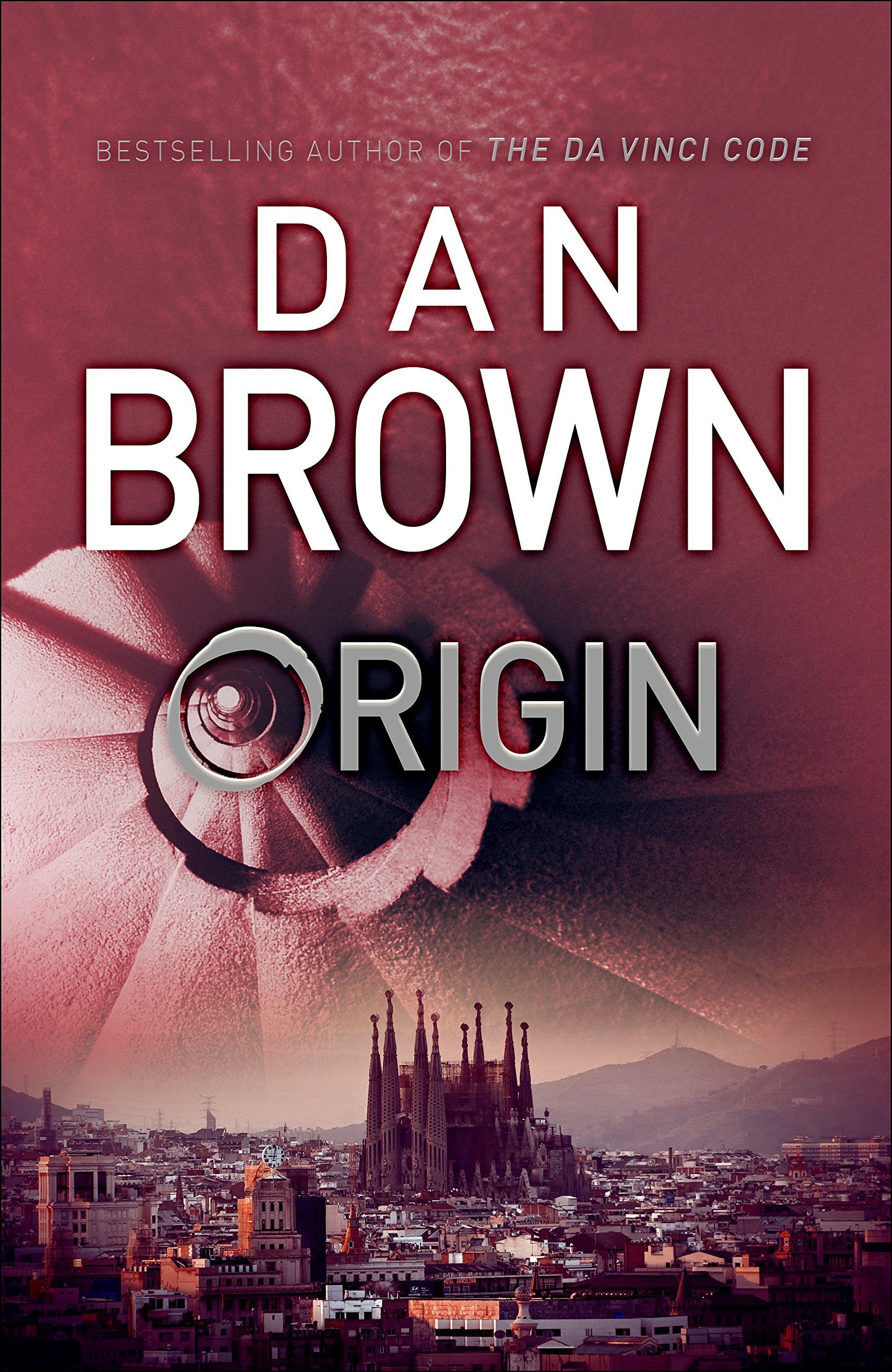
Dan Brown - Origin, Penguin Random House 2017

Considering how prejudiced I was against Dan Brown before reading this book, it is amazing how much of an advocate of his I became now, at the end of Origin's 538 pages. But it didn't even take that long. By page 100 I think, I was already converted.

I have seen the Inferno movie first, and that that probably helped, because I could only imagine Professor Langdon as Tom Hanks. And I am actually looking forward to the Origin movie, actually, though by the looks of it they're still working on making The Lost Symbol, so probably a good few years away.

Now, don't get me wrong: I don't think Dan Brown is the be all end all, I don't think Jesus had offspring or that some dude with a computer discovered the origin of life. In fact I am quite annoyed with the way some of the premises are looked at - the idea that a scientific certainty on the origin of life would eliminate religion (sic!). Well, myself and a few friends of mine, such as Karl Popper or Thomas Kuhn might have a few things to say about this idea of 'scientific certainty' and it's obvious that Mr Brown, talented storyteller as he might be - is missing a few important reads. In fairness though, it is much more exciting to go and visit Sagrada Familia or the monastery of Montserrat then write about them than researching some obscure academics and their dry lectures on epistemology. So I don't agree with the writer, but I sympathize.

The selling point of the book, and - I imagine - the reason behind Dan Brown's success, is his truly captivating storytelling: enough threads to keep one interested, but not enough to make it too complicated; very short chapters and quick jumps from one plot to another; non-linear story-telling on top of a clear chronological thread; putting most of the enigmas out in the open from the off, but always leaving something to discover; and throwing enough red herrings to keep things spicy, but keeping one final reveal.

And despite the omnipresent issue of the lack of a serious, in-depth, analytical approach to all the 'big facts' postulated, the ending is good enough to offset some of the silliness of the beginning premise.

No least, sympathy for the bad guy, something rare in literature and actually rather difficult to achieve. Admiral Avila is a likeable, well crafted character and he's got a chance to become memorable, despite a rather unbelievable end.

I do have a number of other issues, but they're all minor: accuracy of Budapest's nightlife, the veneration of Winston Churchill, the (potentially deliberate) misunderstanding of Catholicism in Spain and the like; things that the American public won't really care about, and the foreign language audience won't insist upon. The fact remains that because of this book I now want to visit the Guggenheim museum in Bilbao, which is no mean feat.

And I also want to read more of Mr Brown's books. But not now, when I'm so looking forward to dipping my head in my ever-growing pile of non-fiction. No, no! In the summer, on the beach. Because, as a holiday read, Dan Brown is really hard to match.

Quotes:

339: 'To permit ignorance is to empower it. To do nothing as our leaders proclaim absurdities is a crime of complacency.'

503: 'Love is from another realm. We cannot manufacture it on demand. Nor can we subdue it when it appears. Love is not our choice to make.'

535: 'I don't believe that the same God who endowed us with sense, reason and intellect intended us to forgo their use?'

luni, 2 septembrie 2019

Love kills

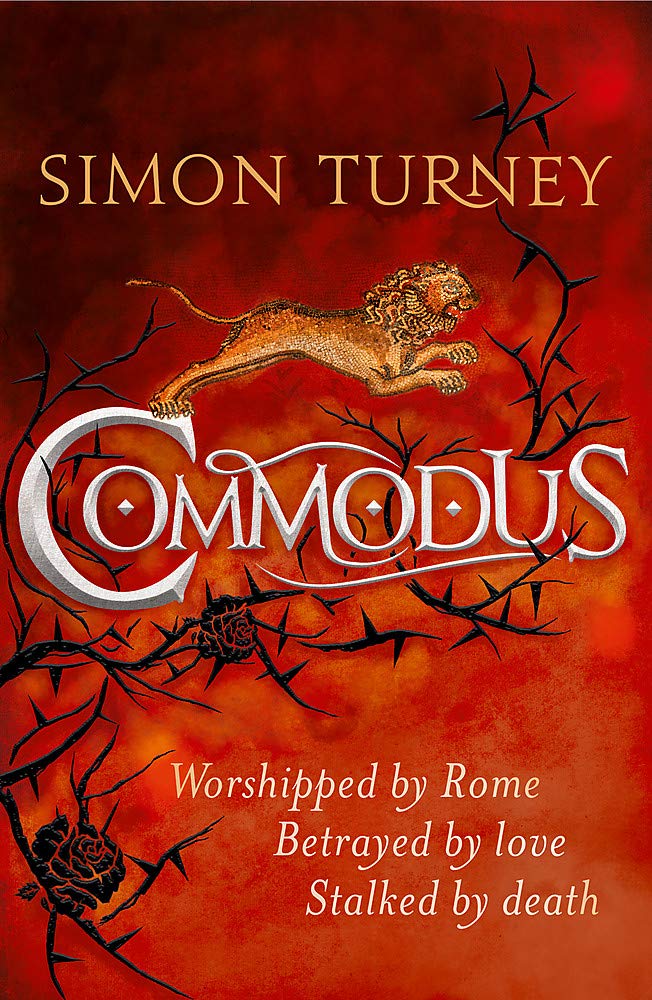
S.J.A. Turney - Commodus (The Damned Emperors),  Orion Books, 2019


Commodus, the infamous son of Marcus Aurelius, emperor at 19 and assassinated at 31, is revisited by Simon in this second iteration of his Damned Emperors series. I say revisited because Commodus is also an important character in the Praetorian series, and I found it particularly interesting to see the same events described from different perspectives. As a fan and reader of most of Simon's books, I have to confess a mild disappointment at the lack of crossover between the storylines, but this book is better served by being a complete stand-alone.

Like the first book of the series, Caligula, Commodus is also narrated by a female character. Julia Livilla, Caligula's sister, is the narrator of his story. Commodus' life is shown through the eyes of Marcia Ceionia, a freed woman and mistress of the emperor, which makes this one something of a love story, an interesting twist indeed for a Simon Turney novel. Only danger is, Marcia is herself a character so interesting that she tends to upstage the protagonist at times. 

In the end, however, having a strong supporting cast (not only Marcia, but also important historical figures such as Marcus Aurelius, Lucius Verus, Lucilla, Pompeianus or Cleander) makes for a rich story and a very gripping read. And although I find it very hard to decide which of Simon's books or series I prefer, Commodus is right up there with the best.

Non-regular readers of Roman fiction will find a rich account of Commodus' life, but also very suspenseful read, especially if they're not particularly familiar with the events of the emperor's life.

And it's a testament to Simon's craft that he can compile such an intricate, rich plot from a relative poverty of sources. This Commodus is a much richer, more developed character than Joaquin Phoenix's portrayal in The Gladiator, and a much more believable one. Also very different, but very similar to the Praetorian series description, is Commodus' sister Lucilla, which, it's obvious by now, Simon does not hold a particularly favourable view of.

A very refreshing addition to the previous portrayals of the emperor is the sympathetic look with which Simon approaches this portrait. Sure, Commodus is far from perfect and some of his decisions are more than questionable, but when he is looked at as a man in his own social and historical context, even if we don't agree with his decisions, we can at least understand what led him to them. Same goes for Marcia who, as the narrator, starts with an inbuilt capital of sympathy from the reader. She is also far from a moral example though, and it is this placement of all characters - including the main villain, Cleander - into an ethical grey area that makes the reader really invested in the story. Even the divine Marcus Aurelius, the emperor-philosopher, who even today enjoys a very respectable reputation even according to the unforgiving Christian dogma, is portrayed here as a man, a special man of good moral standing sure, but also subject to human emotions and mistakes.

A relatively bulky book, Commodus, stands at almost 500 pages in the hardcover edition, but I found it gripping enough that I galloped through its chapters and carved time wherever I could in my daily routine so that I can see what happens next. One of those happy situations in which you want to get as far ahead in the book as quick as possible, while at the same time regretting the fact that it's drawing to an end, and missing the book's universe once it's finished. Hopefully, the third iteration of the series will come before too long.

miercuri, 12 iunie 2019

How to talk about Dracula to non-Romanians

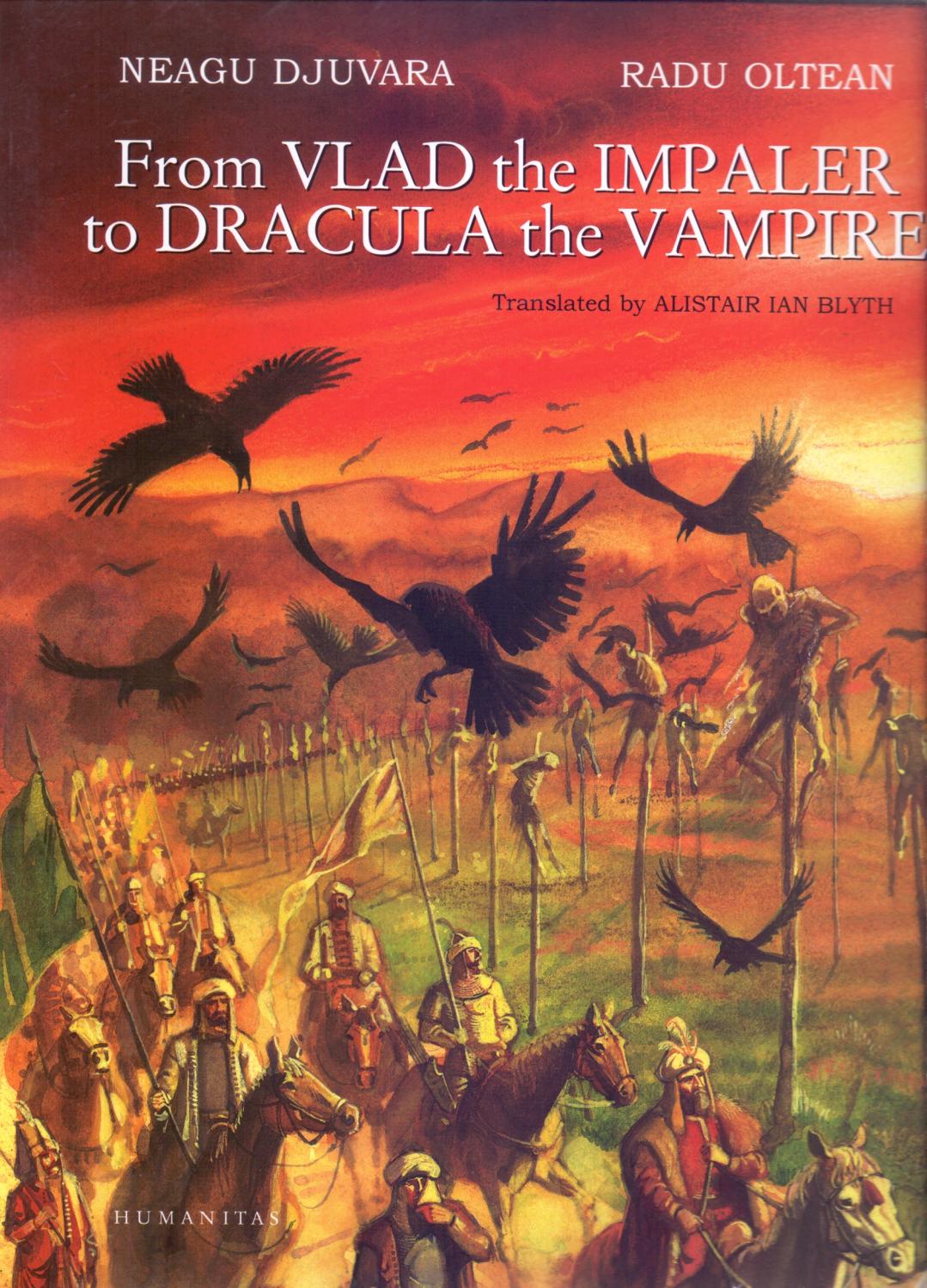
Neagu Djuvara, Radu Oltean - From Vlad the Impaler to Dracula the Vampire, Humanitas, 2003 (Translated by Alistair Ian Blyth)

I have a huge respect for Neagu Djuvara. His book, Civilizations and Historical Patterns (Civilizatii si tipare istorice) has greatly influenced the way I think about history. I consider myself lucky to have had the opportunity to chat with the great man a few times.

In have huge respect for Radu Oltean as well who, in his field - historical illustration, is hailed as one of the best in the world, and for good reason. I am lucky once more to witness Radu's work as it's being made, on his Facebook page. 

And, credit goes where credit is due, Alistair Ian Blyth is the most active translator of Romanian into English at the moment, and his services to Romanian culture should not be underestimated.

For these reasons alone, this is a book I highly recommend to all ages, even though it's marketed as a children's book. And perhaps herein lies the problem. Because yes, there is a problem, despite the meeting of the three aforementioned great minds. As previous readers noticed already, as a literary achievement the book doesn't quite hit the mark. On the one hand, the tone of the writing tends to be very condescending, as if kids need a watering down of the information to understand it. And yes, it is written in Djuvara's old age, but it looks like the historian fell into a relatively common trap: underestimating your audience. I feel the historical rigor and objectivity could have been preserved without any loss of understanding from the audience, however young.

The second issue is the over-apologetic tone in regards to Vlad's bloody deeds. This is, again, a miscalculation: owning the fact that Vlad was a very bloody leader even for the standards of his time would not, in my opinion, damage his reputation as much as trying to present a sanitized version of history does. And I'm surprised Radu signed off on the book (though I presume words belong entirely to Mr Djuvara), as he is famously a fierce enemy of sanitizing history.

However, once we get over these two shortcomings, what we have on our hands is a wonderfully documented gallop through the saga of the Draculesti dynasty and its place in the politics of the time, with a long digression about Iancu and the House of Hunyadi, important as it gave two of the most famous historical figures for both Romanian and Hungarian history. There is plenty to learn even for the reader that has passed through the Romanian education system and is relatively familiar with the reign and times of Vlad the Impaler, there is loads to learn for the reader unfamiliar with the historical figure, but that has maybe heard of the Dracula myth.

And,as it's also been mentioned before in the online reviews, the book is worth its price for the illustrations alone. While I'm trying to not be too reverent to Radu, largely because we often clash in online conversations, his work is indeed magnificent. Largely respecting the canonical imagery and often inspired by period depictions, his touch blows life into the characters making them relatable in a way in which text is unable to. 

I am glad I read this and I can only imagine what one of my historical fiction writing friends might do should they feel inspired by it. Romania has had its share of historical fiction writers, though the work I came in contact with was largely dogmatic, with a clear nationalist agenda. A reckoning between my country and its own history is yet to take place, an honest acceptance and conciliation with our past is yet to be made. And fictionalizing history so that it becomes accessible to the general public, retelling the Dracula myth as it happened, is part of that reckoning.

luni, 22 aprilie 2019

The Trebizond Chronicles

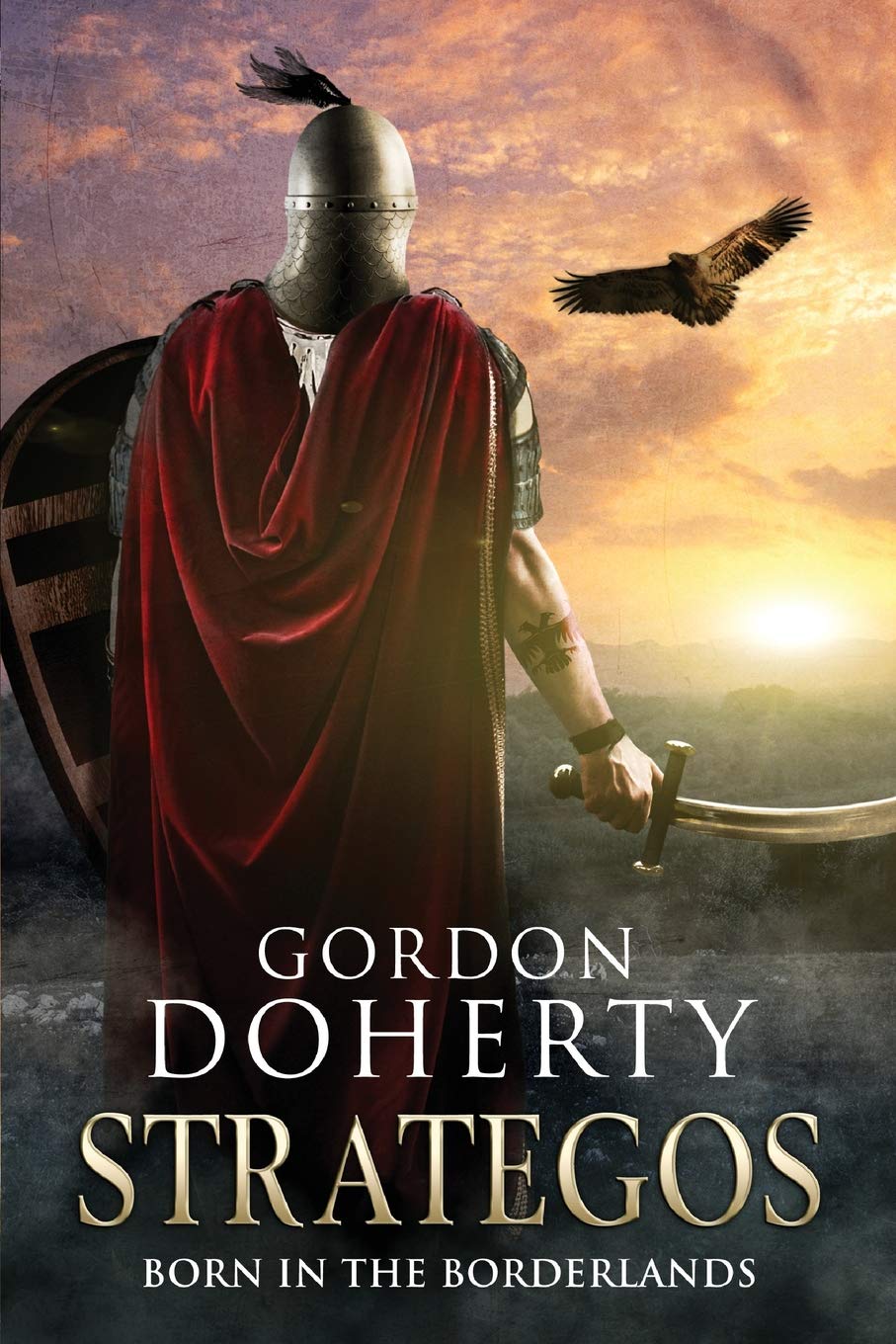
Gordon Doherty - Strategos: Born in the Borderlands, self-published, 2011

A while ago I read Gordon's book Legionary and I emailed him a rather unfavorable review, asking if he'd rather have it published or not. Writing is a tough career and anyone who takes to the paper should be encouraged, not slighted, so we agreed that I wouldn't publish anything about it online. Looking back, Legionary is actually quite a fun action histfic, so I might give the series another chance in the future. But what stroke me then was how gracious Gordon was in receiving criticism and responding to it; a reputation he has since enhanced and it's upheld by his online comments wherever you look. Therefore, while the quality of Gordon's writing will be under scrutiny below, his character is beyond doubt, and I am grateful for his friendship.

Strategos has been sat in my Kindle for a while and I only got round to it now as I realized my reading is a lot faster when I use an electronic device. I shall now devour the entire trilogy very soon.

After approaching a difficult historical period with Legionary (376 AD, NE border of the Roman Empire), Gordon does one up with Strategos, going headlong into a time and a place that is largely ignored by mainstream Western culture: 1046 AD, Eastern Anatolia. While the Byzantine Empire is still far from its conventional 1453 end, this is an era when the empire's border are continually shrinking and, more importantly, at the Eastern border of the empire two major civilizations meet and mix, often through very violent means.

The sources available for the period are scarce, which gives an author room to maneuver their plot however they feel without fearing accusations on inaccuracy, but also makes creating the atmosphere and the flavor of the era difficult, not to mention the huge burden of perception: it is likely that the general public will take their information of a historical era from fiction rather than from documents or research, which puts a great responsibility on writers exploring historical dark patches and blurs the line between a writer and a historian. I am not sure what the writer's intention is here, but it is now clear that - while creating the right flavor of the era is open to discussion - Gordon excels in creating a tense and engrossing plot, the kind that makes your brain want to keep reading long after the eyes have had enough.

The plot and the tension in the action is by far the best thing in the book IMO. Beyond any nitpicking I might do in regards to the Byzantine outlook on life or the existence and functions of secret societies in late Byzantium or the strategic thinking of Byzantine emperors, I was engrossed in the book pretty much from the off and I kept wanting to find out whatever will come of Apion or Cydones or Bracchus next.

I like how twisted the plot is, how unpredictable the fate of all the characters is and how even the villains have a redeeming back story while the heroes can be led to virtuous actions by questionable goals. There's a lot of depth to all the characters that survive beyond a few pages, and it's well spread throughout, each episode adding another single element to one particular character's story.

I also like how Gordon doesn't shy away from writing sex scenes, and in Strategos there's a few of them, but they're all well integrated in the story and avoid the usual cringe that sex scenes seem to generate when written. There's plenty of blood and gore, sure, and writing battles and fights is the bread and butter of most historical fiction writers, but they tend to tread a lot more cautiously when it comes to the romantic lives of their characters. Not Gordon. His characters have feelings and urges and this gives them an extra dimension to the regular 'good with a sword' routine.

All in all, a gripping and pleasant read, and one that sparks interest in an unfairly overlooked era. I have a few reservations about moments in the plot that I think require too much of a suspension of belief, but then doesn't any work of fiction require some suspension of belief?

marți, 31 iulie 2018

The Spectrum of Normality

Paul Wady - Guerilla Aspies (A Neurotypical Society Infiltration Manual), Free Autistic Press, 2014

Paul Wady is autistic, but what that means exactly is a raging debate in some circles. The regular reader would be unacquainted with a number of terms throughout this book and would most likely think of autism as a 'disease'. The short, simple definition of autism is that it's a 'developmental disability', though the autistic people I met would argue against the use of the term 'disability'. Frankly, I think the autistic people I met would argue against anything, but that's beside the point.

What is certain is that very little is known about autism at the level of the regular Joe, while my impression, after a few months of intense reading about autism, is that science doesn't really know what to make of it just yet.

While there seems to be a whole community of socially functioning individuals diagnosed as autistic who developed, in the UK at least, a real subculture of marginalized social groups, somewhat like the 'gay culture' of a few decades ago, there are also a lot of autistic individuals who struggle to integrate socially or indeed to function at all. They seem to be the main intended readership of this book, though I think the book is potentially even more valuable for young autistic individuals who are trying to understand, learn and mimic social behavior, as well as for neurotypical (or 'normal', if you will, though is a term I abhor) readers who have an interest in learning about autism. The value of this book comes mostly from the fact that it presents an inside point of view, it's an inside out look with no pretense of having any medical value, but potentially more valuable when it comes to understanding autism.

The book is largely based on personal experience, all the advice given fits into the writer's own journey and may or may not work for anyone else. But of this we get plenty of warning, unlike a lot of places within the book where the reader is actively and in all seriousness advised to break the law in ways that range up to violent homicide, only to reveal the joke later on. I take this as an indication that it is not actually an instruction manual, but rather an information manual: it provides a way of looking at the world that is potentially inaccessible to the reader, but without indicating what to do with this newly gained view.

Surprisingly, valuable as it might be, is not the informative aspect that I found the best about the book, but the emotional one: it starts off as a very funny read, almost a stand-up number in written form, but then Paul starts to gradually recount episodes of his life or episodes that autistic people encounter on a regular basis, and the tone shifts towards extreme sadness by the end of the book. In trying to describe what it is to be autistic, Paul Wady manages to describe what it is to be human: a hot mess of inconsistencies, irregularities, broken promises, peculiar social conventions and things said with no intention of acting upon them. We have long suspected that a conscious being would struggle to understand large swathes of the human behavior when given the opportunity to study it from outside. Well, Paul Wady is that conscious being. And despite some carelessness in editing or structure, this book is a very good mirror in which we can see ourselves. This is the image that's both funny and sad.

joi, 19 iulie 2018

Green Green Horse at Home

Simon Armitage - Sir Gawain and the Green Knight, Faber and Faber, 2007

Is this like... alien knight or smth?
Sir Gawain and the Green Knight is a medieval poem, written around 1400 in Middle English, of which Simon Armitage's decade-old rendition into modern English is the latest one. The poem draws on the Arthurian legends, though it is not contemporary to them in any way: the themes, language and atmosphere of the poem are a lot closer to the 14th century than the 6th century in which the Tales of the Round table originated: not only is it filled with Christian symbolism, but the attitudes and behavior of characters is a lot more representative of the late Middle Ages. Of course, Arthur and his knights could not have been Christian, though latter writers have not only made them so, but have slowly overlayed upon them motif after motif of medieval Christian virtue.

Such is the case here, where the unknown medieval author anchors the Camelot crowd firmly into the Christian values, so much so that our hero's shield is built along the coordinates of the star of David and has the face of the Holy Virgin painted on. The antagonist, the Green Knight, is probably the remnant of the Pagan era, hence his casting as the bad guy. While the medieval poet does not delve into the Green Knight's origins, his unusual, unnatural green coloring is reminiscent of the worshiping of nature that druid-wizards like Merlin were practicing. In addition, the Green Knight reveals a direct connection to Merlin towards the end of the poem, while his dwelling place is a 'green church', 'a ghostly cathedral overgrown with grass' (2190). Might it be then that Sir Gawain and the Green Knight is an attempt from the medieval poet to recover the druidic myths and traditions, to draw the attention of his contemporaries to them? The equation of Christmas with Yuletide is another argument to that, but you will need a better prepared scholar than myself for a definite answer.

The synopsis is relatively simple: during the Christmas feast a weird-looking Green Knight shows up at King Arthur's palace and issues a strange challenge: he will take an axe blow to the neck in exchange for returning it a year later. As the most virtuous of Arthur's knights, Gawain raises to accept the challenge, which means his next year is spent in search of the mysterious Green Knight whose chopped head left only a vague clue as to his whereabouts. As it happens, Gawain does discover the location of the knight's Green Church just in time, though in true epic poem tradition, more tests need to be passed before Gawain manages to reach that which, on the face of it, will mean his earthly end. Of course, the resolution is favorable to our hero, though there is a twist at the end with an important moral signification.

The modern reader is, of course, required to suspend his belief in regards to a series of motifs, actions of motivations throughout: how can a man be green? who issues such an outlandish challenge and, furthermore, who's silly enough to accept it rather than dismissing it as useless or childish? how can a beheaded man speak or ride and, most importantly, how is it that it just so happens that Gawain finds the green church just in the nick of time? Oh, God directed his step? I see, it all makes sense now.

That being said, the poem is largely entertaining, and one must appreciate how, in the tradition of Arthurian legends, the resolution is not as straightforward as in the typical fairy-tale. The good example walks hand in hand with the cautionary tale. Not to mention, the abundance of detail regarding castles' layout, hunting or dining habits are not only very valuable for historians and scholars, but also highly atmospheric. Plus, I love how the medieval poet is not tied by the rigors of modern writing, pacing it as slow as he likes in places that have no bearing whatsoever to the main plot, such as the butchering of the game - shown in great detail - while a few months' worth of adventures are dismissed as they're 'too long to tell here'. Sure, why the hell not, nevermind what the hero did, tell me more about how to chop a deer leg. This sort of detail, regardless how valuable or atmospheric, can become overbearing for the average reader, but luckily this particular poem is of acceptable length and, at least in Simon Armitage's rendition, quite readable.

In regards to the this particular rendition, I think Simon Armitage has done a decent job, though there are places where modern language creeps in on top of medieval structures and it sounds as out of place as a scratched record. The story is entirely preserved, but there are places where the language is butchered. IMHO, a greater care should have been taken to ensure the language preserves the medieval atmosphere and, if something had to be sacrificed, then maybe the poetic structure should be the first victim.

So, is this poem teaching us anything? Well, nothing of huge relevance, but for nostalgics of Arthurian legends like myself, it's a good light reading for a summer afternoon in the park.

Quote:

'Why should I shy away? If fate is kind or cruel man still must try.' (560)

sâmbătă, 9 decembrie 2017

Edge of Empire

S.J.A. Turney - Praetorian III: Eagles of Dacia, Mulcahy Books, 2017

There are two main reasons this book is special to me: it is the first time Simon writes about Dacia (and it's my first contemporary read about Dacia written by a non-Romanian) and I get a mention in the book dedications. While a huge honour and an unexpected surprise, I also believe this to be rather undeserved, though I shall accept it nonetheless.

After a quick rise through the ranks in the first book of the series and just as quick a fall from grace in the second, Gnaeus Rustius Rufinus is sent to Dacia in something that is halfway between a mission (to check the loyalty of the governors) and an exile (Cleander, the imperial chamberlain wanting to send him as far away as possible from Rome). It is this journey that is covered in the book, plus a whole bunch of trouble that Rufinus has a real talent for getting himself into.

Rufinus is accompanied by Senova, the freed slave girl he meets and falls in love with in the first book, and Acheron - the dog he acquires from the dead Sarmatian guard Dis, also in the first book. On the way they'll acquire a slave boy, Luca, putting the numbers of the travelling party up to 4 (5 if we consider Atalanta the mare). The journey starts immediately outside Dacia, in the province of Moesia, and so does the intrigue. An adventure full of twists and bumps follows, taking our heroes at the Northernmost reaches of the empire, followed by a journey down through barbarian lands and an unexpected end point. It's hard to speak too much about the plot without giving away the pleasure of discovering it, as Simon does a fine job of always adding unexpected turns. Therefore, even this is a book centered around a journey, there's plenty of adventure to be had on the way, peppered with the usual sieges, battles and fights.

I suppose one way of looking at the Praetorian series is that adventure is the substance being molded into the various shapes of each book: political intrigue in the first, addiction and fall from grace in the second, travelling and discovery of exotic lands in this third. And all of this is backed by Simon's excellent documentation and research, recreating the atmosphere of late 2nd century Rome in fine detail. This recreation of the atmosphere includes gems like 'They had acquired four local guards with unpronounceable names, only a dozen teeth between them and less command of Latin than your average pomegranate.' or 'A good punishment detail will change arms with each stroke so that the blows cross and do more harm.' They don't teach this kind of stuff in religious studies.

While all the story-lines in the Praetorian series are works of fiction, they are based around important historical events, and although we do not know of the historical existence of any Praetorian soldier called Rufinus, the historical characters in the books are captured not only accurately, but by giving them a real voice it becomes very easy to understand their thoughts and motivations. After we've met Marcus Aurelius and Commodus in the first book, Pertinax and Septimius Severus in the second, in Praetorian III we get introduced to two other Roman emperors, namely Clodius Albinus and Pescennius Niger, bringing the gallery of emperors in the Praetorian series up to an impressive six so far (although 3 of them will have a very short lived reign). But while the list of Roman Emperors reads Commodus (177-192) - Pertinax (193) - Didius Julianus (193) - Pescennius Niger (193) - Clodius Albinus (193) - Sepimius Severus (193-211), having them as characters in a book gives a better understanding of how the wheels of the 'great game' spin.

There are three elements that I particularly appreciate about Praetorian III, though I will only mention each of them without too much details, with a view to the same care I mentioned earlier, not to spoil the book for people who might read this review first:
 - the mirror journey: over the course of two weeks in April 2017 Simon took a trip largely along the route he will send Rufinus on, later in the year. There is a bonus feature in the book that makes the reader part of both adventures;
 - the gold mines plot: contemporary sources give the gold of the Western Carpathians as one of the main reasons for Trajan's invasion of Dacia. Impressive quantities of gold are mentioned in relation to Trajan's plundering of the province, but more impressive still is the fact that 19 centuries later Gabriel Resources spent an alleged $17 million in bribes for the rights to keep mining gold from a region where gold has been mined since Roman times. It is therefore right that the gold mines at Alburnus Maior feature heavily in the plot of Praetorian III and Simon has found a way to do this that is entirely believable.
 - the end twist: I will not say much about it, obviously, just that I am rather excited about Rufinus' new patron and I am therefore looking forward to Praetorian IV. Late 2018, I hear.

duminică, 29 octombrie 2017

American burlesque

Liz Goldwyn - Pretty Things (The Last Generation of American Burlesque Queens), Regan, 2006

This is an excellent resource for anyone with an interest in burlesque as an art form, though unfortunately it falls short of being a great book in itself as the author hesitates between publishing a coffee table book, a costume note archive or a history of the movement.

I'm not a big fan or consumer of coffee table books, but I can understand their purpose. Pretty Things checks all the boxes of the definition of one such book, though it is larger in scope, aiming to document an entire cultural sub-genre. In the process of documenting the book, Liz Goldwyn stumbled upon a real treasure: Rex Huntington's books, notes and ledgers. Rex Huntington was one of the most prominent costume designers of the burlesque era, so his archive documents a lot of the burlesque dancers' measurements and designs. Therefore, for any burlesque scholar, this is an invaluable resource and publishing it in its entirety would have been an excellent idea, even if the appeal would have been a lot narrower. As it is, there are a lot more of Rex Huntington's notes being left out than there are included, which can be frustrating for the meticulous researcher.

Same goes for documenting the stories of burlesque dancers: due to editorial space limitations only a small number of pictures are included and the approach towards individual stories of the dancers is journalistic in style, too shallow and too brief to do them justice. 

This is still a great book and a must-read for anyone with a degree of involvement in the art, but IMHO it fails to engross the wider public. 

The book is divided in two sections, the first one documenting the craft of what was generally called burlesque in early 20th century America (with chapters dedicated to costumes, staging, dance, gimmicks, backstage life and a generic profiling of the burlesque dancer), whilst the second part is dedicated to individual stories (Betty & Dian Rowland, June St. Clair, Lois de Fee and Zorita).

To me, the second part is a lot more interesting, and the piecing together of the lives of these ladies from the elite of the craft provides a real insight into burlesque as it was 100 or so years ago. Each of their stories is interesting, each of them makes me want to know more about them. Would Miss Goldwyn venture to write full biographies for these ladies I wonder?

Quotes:

'What is there to like? Hairy chests? A limp joint? You like them because they're customers, because they admire you, because they applaud, because they spend their money to see you.'
In the early 1950s, Zorita had a child with her second husband, Pete Petillo ('the wop'). The marriage didn't last long, as Zorita wanted to get back to work. She took her daughter to the theater with her, adjusting her routine to include a new baby.

Zorita spoke of her career in burlesque with pride but was not particularly nostalgic for days long past. She kept many scrapbooks on the shelf and told me that until I asked her to pull them out, she hadn't looked at them in years. She said 'Wouldn't you hate to live with somebody that was so hung up on oneself that they were busy looking at scrapbooks all day long and telling you what a great act they were? I know I was good.'

marți, 24 octombrie 2017

Overcoming grief

Rio Ferdinand (with Decca Aitkenhead) - Thinking Out Loud, Hodder & Stoughton, 2017

Repeatedly, during the reading of the book and whilst attending its launch, I took the opportunity to mentally apologize to Rio for all the times I have judged him before understanding him. Luckily enough, he's been a good enough footballer that I have next to nothing to reproach him. Sure, there will always be THAT loss against Portsmouth in 2008, when we missed the chance of a second treble, but singling Rio out for it is too harsh to be accurate. No, no, I've never had an issue with Rio on a football pitch, the defender with the best placement I've ever seen, in the league with Maldini or Baresi.

The issues I've had with Rio, historically, are related to his apparent craving for media attention, the work put in developing the Rio Ferdinand brand sometimes seemingly being prioritized over the work of being the best possible Manchester United team player. It is the lot of the football fan, though, is it not? To hold his heroes to standards impossible to live up to. Once Rio left United for QPR, all of the silly grudges have gone. I've wanted the best for him and I really wanted him to do well at QPR, being very surprised when he didn't. Then one autumn day two years ago, while checking the BBC website for results I saw the news of his wife passing. It sent shock-waves down my spine and through the football world throughout. How can one protect oneself from such a tragedy? Why have I been so quick to judge his form without having any background?

Well, few can cope as well as Rio has. And this book tells the story of how he's done it. I have to admit, even when hearing about the documentary, then the book, I was suspicious. Is this banking on a tragedy? I know now that he's not that man. On the contrary. The documentary (which I am yet to see), the book and the talks Rio is currently doing in various locations are an altruistic enterprise. They're meant to share his experiences, his coping with tragedy, and in doing so, the hope is he'll help people who have or will experience similar traumatic experiences.

This is a football biography unlike any other football biography: the sport only stays in the background and despite the insights into Rio's footballing life, the book centers on his family life. Meeting Rebecca - his future wife, their years together, the tough time of acting as a single parent while his wife was being treated for cancer and finally, his struggle to keep going and having to fulfill, this time for good, the roles of both mum and dad for his three kids.

Sure, due to his footballing talents Rio has had, since his mid-teens, a privileged life, and he doesn't shy away from it. But looking too much at the story from this angle doesn't do justice to anyone, least so to Rio. Tragedy is tragedy, and no amount of wealth or social privilege can protect you from it.

Not having experienced a loss as big as Rio's, I don't know how it feels. But I know that if, God forbid, I would suffer such a loss, I'd like to have a book like this close. And I feel it is a great instrument and has the potential to help a lot of people that go through similar experiences.

I cried a number of times while reading it, and there's also a lot of cute moments in the book, specially when he talks about the relationship with his kids.

Writing this book has been an enormous act of courage for Rio and shows both his strength of characters and his generosity. It is a great read, and I now think of it as a very peculiar cross between biography, self-help book and great literature.

Having experienced the death of his mother less than two years after his wife's was soul-crushing even for me when hearing the news. I can only imagine how poor Rio must've felt. All the more admirable that he chose to go through with his projects, all the more admirable to see him weekly in Sky's pundit chair. Even with this review, I feel I've been too harsh with a very admirable man and a great footballer. I'll end with a little story that is, I think, illustrative for Rio's character:

Earlier this month, when attending the launch of the book, we were told that a book is included in the price of the ticket, but there will be no signings, autograph sessions or photo-ops. And it was indeed an unfitting atmosphere for a meet-up between a footballer and his fans: most people in the audience were either recently bereaved or healthcare professionals, Rio's family and close friends were there and yes, there were a few Manchester United jerseys in the room, but they were in no way a focus. At the end, however, ignoring the organizer's advice and venue security's orders, Rio stayed and signed all the books that he was requested to, took all the pictures with everyone who asked him to and was generally an all-round gracious host.

I now feel sorry for ever being judgmental about Rio. Whenever I see him nowadays, whether on TV or in a picture, I just want to give him a big hug.

duminică, 9 iulie 2017

X out of X

S.J.A. Turney - Marius' Mules X: Fields of Mars, Victrix Books, 2016

 Reviewing the tenth book in a series is really just for people who are already familiar with the series to some degree. If you're not familiar with Simon's Marius' Mules (the Falerii saga) I shall refer you to the first book. But be prepared for a binge read of 10+1 volumes, to which Simon says will add another five books. I don't personally agree with his idea of sticking religiously to the timeline of Caesar's diaries as some years of the Gallic wars are rather uneventful, whereas the year of the Arveni revolt could easily fill two or three volumes. Nor am I too happy about the prospect of the series ending with Caesar's assassination (oh, yeah, spoiler, Caesar dies in 44 BC). Because regardless of how it might've started out, this is not the story of Julius Caesar, but of Marcus Falerius Fronto and maybe, just maybe, the saga of the Falerii, depending on how much convincing Simon will need in a few years' time, once he has ran past the events on the Ides of March. What will Fronto do during the battle of Philippi for instance, a real war of brothers, where friends of his will be pitted against each other? What about Actium? Will he manage to be neutral in the battle that marks the de facto end of the Republic? I guess we shall have to wait and see.


In the meanwhile, Fields of Mars is Simon's treatment of 49 BC, the first year of the Civil War that will see the end of the First Triumvirate. It is the year of the Rubicon crossing (along with the famous 'Alea jacta est') and the year by whose end Caesar will secure the loyalty of Italia and Hispania, thus controlling what will later be known as the Western Roman Empire and setting up the decisive clash with Pompey in Greece. 

Unlike the Gallic wars, this is a civil war and will therefore involve as much diplomacy as it will need fighting. Simon, who clearly enjoys writing the latter more, is bemoaning the fact, although I think he does a pretty fine job writing negotiations and politics and it keeps an alert pace throughout the book, even though yes, the maneuvering takes more pages than the actual fighting.

I remember reading Caesar's diaries and being impressed with the siege works built for the taking of Massilia. All of it is well fleshed by Simon, though only after he decides to take Fronto on a tour of Hispania through which his sword gets bloodied a lot less than we're used to.

But there's two major achievements here that make the volume stand out within the series: 

1. The Naval Battle of Massilia. It is, as far as I remember, the biggest naval conflagration Fronto has come across so far and Simon proves he is just as ease writing naval strategy as he is writing field battles or sieges. There's some really spectacular pages there, once again the entertainment factor being doubled by a great history and military history lesson, just as Simon's extremely exhaustive knowledge of the period - in full display here - is double by a very gifted pen.

2. Salvius Cursor. This is a fictional character, and a new addition to the impressive panoply of figures and archetypes of the era. Because Fronto needs an antagonist while Caesar is too edgy and there's not enough fighting to pick someone from the opposing side, it is the legatus' second in command that serves as opposing pole to our man from Puteoli here. I don't want to give too much away, but just like with Cavarinos in The Great Revolt, Simon achieves an impressive feat in creating a character that walks many miles in the grey area between positive and negative without ever really touching its black and white borders. Applying modern military norms, I'm tempted to say Salvius' insubordination would have brought him a much swifter exit either via a metallic tip or via stripping of any sort of military capacity, which tends to happen once a direct order is disobeyed. For the sake of a good read, however, I am tempted to grant this suspension of belief, if only to satisfy my curiosity as to where this feisty tribune will eventually end up.

Another cute addition - and it'd be really funny if this were in any way true - is the Gallic Defense Fund, chests of treasure that allegedly were meant to secure Rome against a further Gallic invasion. Along with other artefacts such as 'legion eagles from the time of the war against Carthage', this has gathered dust in the cellars of the Temple to Saturn ever since the time of Brennus and all the way up to it being plundered by Fronto. Come on, is our legate not at the very center of history?

And I shall end my review with a few nuggets of Julian wisdom, via the Turney spectacles:

'Unprepared men lose wars, Fronto' - Caesar acknowledging the de facto state of war.

'I do not like to leave things to chance if I have the option to prepare.' - this reminded me of a favourite Arab saying of mine: 'Put your faith in Allah, but make sure you tied your camel.'

'I have no wish to come between a man and his conscience' - Caesar letting go of Labienus. Titus Labienus' appearance in Caesar's diaries during Civil Wars is so brief that the rift must've been painful. very curious how Simon will handle it.

'First we deal with an army without a general. Then we can deal with the general without an army.' - another reminder of another quote I enjoy, this time by Alexander, allegedly ahead of the battle of Gaugamela: 'I do not fear an army of lions led by a sheep. I fear an army of sheep led by a lion.'

So there. If you haven't read MM so far, go back to book 1, you've got some ground to make up. If you're up to date, join the crowd in awaiting for Marius' Mules XI. Coming 2018, 2066 years after the fact.

sâmbătă, 4 martie 2017

Albania Rule the Waves

S.J.A. Turney - Tales of the Empire V: Invasion, Canelo, 2017

Despite being a big fan of Simon's books, I have so far avoided his 'Tales of the Empire' series mostly due to the word 'fantasy' he uses is the description. I was wrong, and this is not a fantasy book. If anything, it is worth of the historical fiction label more so than the Marius' Mules or Praetorian series which are fictionalization of history, or historical fictionalization, if you will. Sounds like a minor difference in spelling, but it becomes obvious in meaning: whereas the two aforementioned series are based on very real and sometimes very well documented events, leaving the author with the sole task of fleshing out the documents and instill some life into characters, Tales of the Empire is completely made up, at least in terms of chronology and location. There is no doubt in anyone's mind when it comes to atmosphere or time period: we are in early empire Rome, and the changed names are not going to fool anyone, nor do they intend to. Simon's only justification for this is to have the freedom to invent his own campaigns and stray from the historical course of events. Alternative history, of sorts, that wretched thing historians hate and writers love.

Invasion deals with the conquest by 'the Empire' of an island just outside the continental mass, by the name of Alba. We are dealing with a reinterpretation of the Roman conquest of Britain in which Queen Cartimandua puts in an appearance in the guise of Verctissa, queen of the Albantes. Unlike any of his historical books though, this one does not have a lead hero on the part of the invaders, but three. There is a silent implication that Lucius Bellacon is the main guy in this story, but it is in fact the story of three Roman officers. I mean Imperial officers, of course.

Which means either or all could be killed at any point during the novel, and I did fear for their lives just like I feared for Fronto's once the main objective of Marius' Mules has been achieved.

Strangely enough, from a military point of view this book might be more accurate than its historical counterparts. It is more specific, for sure. The readers will familiarize themselves with Roman use of artillery in battles and the purposes and functionalities of scorpion bolt throwers. Plenty to cherish for the lovers of close combat or commando missions too, but I feel artillery is really the department that gets the bigger slice of this pie.

I bookmarked a self-sacrificial scene worthy to stay right next to the Oscar-nominated Hacksaw Ridge. Self-sacrifice for your fellow soldiers always makes for a good story, the only difference between this and Mel Gibson's is that Simon's soldiers do not consciously object to any sort on violence. Quite the opposite, actually.

Also in line with Simon's sympathetic view of the natives, we are introduced to Lissa, a native seer slave who is a key accompaniment to the action and the alleged story teller. Her background story is barely sketched, and for such an important character there are lots of gaps in her personal history. Just enough to fill up a book, I suppose, and I'm pretty sure there is a readership awaiting for that book, too.

Invasion ends just as it was predictable, so much so that Lissa sees the end from the very beginning: it's the conquerors' boot on the natives' neck and the conqueror's flag on top of the mud huts. But knowing the end of the journey takes nothing away from the pleasure of getting there, as it is often the case with Simon's writings.

I am, upon reading Invasion, intrigued by the 'Tales of the Empire' series and I shall take on to reading it. There is talk of Khans plundering the capital, how can one not want to see what's it all about in this beautiful historical mash-up with changed names?