sâmbătă, 30 mai 2015

Inglorious Singularii (Dirty Contubernia)

S.J.A. Turney - Marius' Mules VI: Caesar's Vow, Victrix Books, 2014

I have finished this book a while ago but I hesitated writing about it because... well because I was under the impression there's not much left to say. I have talked in my previous reviews about how brilliant Simon's books are and how much I enjoy them, and this is always the bottom line. I can only imagine how hard must be for Simon to be keeping writing on the series, and I am always surprised by the energy with which he does it. Because with long series like this you always run into a conundrum: your audience will always want to more about the heroes. They get bored by always being fed more of the same, but at the same time you cannot afford to innovate to much without risking to either making the story too unbelievable or changing the characters so much that they become unrecognizable when compared to their previous selves. That's why a lot of TV series have a dip in quality after two or three seasons.

Having said all that, with this sixth book of the series Simon proves to be a masterful innovator, in that the action develops in a surprising way, while the characters stay true to themselves. At the same time, the historical reality of Caesar's diaries is respected as well, as Simon is very intelligently exploiting a gap in the historical timeline, namely what happened to the rebel king Ambiorix of the Eburones. It is clear that Ambiorix's deed of destroying an entire legion and killing two high ranking officers (Sabinus and Cotta) is the biggest failure of Caesar's Gallic campaigns, with probably heavier losses than even the Battle of Alesia. 

After a bit of a rocky and only partial reconciliation with the general, our hero, Fronto, is given a commando and a mission. This is a turn of events as clever as it is surprising, as it frees Simon to take Fronto and his 20-odd men wherever he pleases. Fans of the series should not be worried, as there is plenty of blood and gore, of hacking and stabbing, though sometimes the numbers are smaller. There are two cult movies this book reminded me of, and they're both referenced in the title. Which makes me rather curious if Simon took any of his inspiration from Tarantino's movie in the same manner in which Inglorious Basterds is inspired by the Lee Marvin classic.

There are a few really great moments in the book, of which one got stuck in my mind due to the depth of the psychological drama: when Fabius has to kill the villagers to whom he promised freedom only moments before, thus going against all his ethical convictions. The army does that to you a lot of the time, and it is captured here surprisingly well.

I need to note a slight disappointment when I think about how fascinated I was about the mythological animals Caesar describes as being part of Northern Gaul's regular fauna and about the longest anthropological inquiry the great man makes into the life of this part of the world in his sixth book of De Bello Gallico. I was eagerly waiting to see what Simon has to say about the weird animal with a horn in the middle of its forehead out of which two pairs of antlers grow. Instead, he dismisses all of it under the label of 'fabulations attempting to mask a military failure'. Which, come to think about it, might very well be true.

So rather than being a mere setup for next year's world-shattering events, this sixth book is actually a great standalone, that can very well be read by itself as well as a natural follow-up to the fifth and the adventures of the previous year. Highly recommended.

Having already read The Great Revolt, I can only say I'm looking forward to reading it again. But before that, Prelude to War, a 'gap-filler'. Very curious.

luni, 25 mai 2015

St. Paul's

Paul McCartney, Out There Tour, 2015-05-24, O2 Arena, London

Unul dintre avantajele unui concert in Londra, spune Paul McCartney, este ca iti poti aduce familia sa te vada. Si mai spune Paul McCartney ca se intreaba ce trebuie sa fie in mintea celor 8 nepoti ai lui, prezenti cu totii la concertul de ieri de la O2, cand stau in sala: "Asta nu e batranelul ala care sta tot timpul intins pe canapea, facand pe bunicul? Wow, e un rock star!"

M-am uitat si eu in seara asta la Paul McCartney si nu mi-a venit sa cred ca batranelul asta e una din cele mai proeminente figuri ale istoriei muzicii, omul care a definit probabil mai mult ca oricine altcineva muzica de azi. Si nu mi-a venit sa cred nu numai ca vad un concert Paul McCartney, dar si ca - vazandu-l pentru a doua oara, dupa Royal Albert Hall in 2012 - stiu la ce sa ma astept.

Arena imensa de la O2, cu acustica ei ciudata si scaunele urcate pana la inaltimi ametitoare face tot posibilul sa diminueze din caldura emanata de muzica de pe scena, dar Paul McCartney a pastrat intacte spiritul, atitudinea, naivitatea si placerea de a canta a anilor '60, cei in care Beatles au schimbat muzica si in buna masura au schimbat lumea. De-asta suna poate altfel astazi Blackbird - melodie compusa din solidaritate cu minoritatea neagra din Statele Unite, si de-asta mi-au dat lacrimile pe Here Today, conversatia cu John Lennon care nu s-a intamplat niciodata. Arata altfel, foarte diferit, lumea de azi fata de cea in care Beatles si-au compus muzica, dar Paul McCartney pare sa fi ramas acelasi.

Melodiile sunt in buna masura reorchestrate, dar asta nu inseamna ca nu sunt la fel de recogniscibile instantaneu. Iar motivul pentru care recunoastem muzica Beatlesilor imediat nu este pentru ca au fost hituri la aparitie - buna parte din audienta din seara asta nu era nascuta cand s-a compus muzica, ci pentru ca muzica Beatlesilor a patruns atat de adanc in fibra societatii incat muzica lor este parte din noi, fie ca o stim sau nu. Mi-e greu sa spun, in contextul asta, cat de privilegiat ma simt ca am avut ocazia sa-l vad si sa-l ascult astazi pe Paul McCartney.

La fel, e greu sa adaugi superlative peste muzica lui Paul McCartney, oricat de uluitor ar fi ca isi pastreaza intacta si atat de evidenta placerea de a fi pe scena si de a canta la mai mult de 50 de ani de cand a devenit superstar.

Majoritatea celor cu sau despre care canta nu mai sunt cu noi. Dus e Mr Marks, cel care a inspirat Temporary Secretary, un synth-pop avangardist si prea putin cunoscut, dusa e Lovely Rita, cea de la care Paul cumpara pui. Demult sunt dusi Eleanor Rigby si Father MacKenzie cu rugaciunea lui, dusi John Lennon si George care a compus Something la ukulele. Dus Frank Sinatra care a spus ca Something e melodia lui preferata de la Lennon/McCartney spre frustrarea amandurora, demult dus Jimmy Hendrix care a invatat Sgt. Pepper's in 36 de ore si il canta la Marquee pe o chitara dezacordata pe care il ruga pe Eric Clapton sa i-o acordeze. Dus si clubul Marquee, inlocuit de Montagu Pyke, un domn cu burta si costum, si dus si posterul din casa lui John Lennon care a inspirat cantecul in beneficiul D-lui Kite. Spectacolul in beneficiul d-lui Kite se va juca insa pentru totdeauna, iar cel pe care l-am vazut in seara asta a fost extraordinar atat prin muzica, cu incarcatura ei emotionala si istorica, dar si imbunatatit incredibil de mult de tehnologie:

Intrarea, cu decorul viu colorat si plin de puncte tipatoare peste care s-a cantat o versiune fidela a lui Eight Days a Week, si-a meritat singura biletul si a reusit sa aduca publicul in atmosfera dupa ceva mai putin de 3 minute, fara nici un fel de trupa de deschidere. Iar urmatoarele vreo 40 de cantece desfasurate pe parcursul a 150 de minute si 3 encore-uri l-au tinut acolo, indiferent ca a fost vorba de clasice ca Yesterday sau Hey Jude, melodii Wings ca celebra Live and Let Die sau compozitii solo ca Maybe I'm Amazed, My Valentine sau cele cateva melodii de pe albumul Art of McCARTney lansat anul trecut.

Se declara uimit ca el, un pusti din Liverpool, a avut ocazia sa cunoasca membri ai guvernului rus si alti asemenea. Ei bine, uimit suntem si eu ca noi, niste murtori de rand, am avut norocul sa-l vedem pe Paul McCartney cantand. Si l-as tot revedea. Macar de opt ori pe saptamana.


vineri, 15 mai 2015

The Roman Shield

A few notes on the design and use of the shield in the Roman Imperial Army following a visit to the Victoria & Albert Museum in London

Simon James Atkinson Turney has lately put his name rather high in the list of my favourite writers. Which led to a strange feeling and an even stranger relationship as Simon, unlike my other favourite writers, is very accessible and very engaging. I think of him, therefore, first and foremost as a social individual and only afterwards an author (I did not say friend as I have only gained this title on facebook, which counts for little).

Simon also does reenactment and sometimes talks about it on his blog. After his most recent Roman adventure I noticed and took particular interest in a picture of his shield. This picture:

I was greatly surprised by the flat wooden grip, as I have always thought the grip of the shield would be the typical two leather straps, one of which goes over the forearm and the second is grabbed by the palm of the left hand. While there is some uncertainty over this, the majority of the researchers and reenacters seem to be convinced this is the grip that was used on the Roman shields. I wasn't. So I went to the closest, most accessible source: Trajan's Column V&A cast. And bam! - here's my proof: 


The two guys in the center of the picture are most certainly Romans (easy to identify by their helmets - with the transverse metal straps reinforcements and the ring at the top - the specially adapted design for the Dacian campaigns). They are also most certainly holding the shield the way I thought they would. It took a while to find them and there are many more instances of the inside of Dacian shields, as the Dacians are on the defensive a lot more. The Dacian shield's grip is identical, but this does not necessarily say anything about the Roman army, unless you count the many occurrences of the two point grip, but even that is circumstantial:


Upon leaving, I noticed something else that would further advance my case: John Deare's Caesar invading Britain (1796):


Pretty obvious, no?


However, Deare's sculpture is useless in this conversation, for a number of reasons: first, it cannot possibly be considered historically accurate, and not only because of the intervening 18 centuries between the events and their depiction. It is highly unlikely Caesar ever looked like Deare depicts him here, or wore clothes that were even remotely similar. Then, remember when I was talking about the innovations of the helmets during the Dacian campaigns? Well, these two helmets are already innovated, almost 2 centuries before. Then we have to consider the influence that medieval weaponry could have had on Deare's conception and questions are hanging around the artist's level of documentation. Furthermore, there is a detail in Deare's pictures that almost blows my case out of the water. Here:


Caesar's grip is also questionable, but how is that guy in the middle holding his shield? And why is his shield square, not round? Or why is he wearing a lorica segmentata, not chain mail like the previous guys? It becomes obvious, no? He is a legionary (heavy infantry), whereas the round shield, chain mail wearing guys are auxiliary (light infantry). Therefore, we have to differentiate between the various bodies of the Roman Army. On the column, we can distinguish three types of Roman shields:

1. The round shield - Celtic in origin and specific to auxiliaries (probably none of them Latin). This has most certainly leather straps for holding in a fight.

2. The square shield - adopted from the Greek hoplites, this is the shield used to create the famous phalanx and the Roman testudos. It is the weapon of the Roman legionaries and the most representative of the Roman shields.

3. The hexagonal shield - as far as I know, this is a typical Roman design, and was used by the Praetorian guard, the elite troops of the army with much less active duty and mostly ceremonial roles.

Far as I could muster, there is no instance of the inside of either a square or a hexagonal shield on Trajan's column. The legions are always in a tidy formation:

This picture reveals little, if anything, about the grip of the shield. Most likely, they are using the wooden handle to hold the shield, but whether there is a leather strap safety or not is hard to say. Straps were apparently used to carry the shield on the march, and it is possible they doubled as a safety hold in the fight.


These guys here seem to have their left hands bent at the elbow, but whether that is accurate depiction or their arms are just badly proportioned is open to debate. The two-dimensional representation is not a big help either.

So this is that. I will keep looking for more details when I get to Bucharest, as the cast of the column there is taken apart and all panels are exhibited at eye level. The conclusion of my visit to the V&A is that while the round, auxiliary shields were held with the arm bent and tied by two leather straps, the likelihood is that legionaries and the praetorian guard held their shields by the wooden handle behind the umbo (the shield boss), arm being kept straight. To me, it seems like this grip is putting a bigger strain on the hand muscles, it offers no insurance in the case of the palm dropping the shield (as opposed to the safety leather strap of the round shield) and takes away entirely the use of the left palm (this is also extremely reduced with the straps, but it is possible to hold another object - be it a pugio or a pilum - while also holding the shield strap). Some of this can be detailed by the reenactors that have actually used one or more types of shields and I am hoping some of them will bring their input.

luni, 6 aprilie 2015

Civil Skirmish

S.J.A. Turney - Marius' Mules V: Hades' Gate, Victrix Books, 2013


With the previous, fourth book of the series, I declared myself disappointed that Fronto is left out of most of the action in the Rhine crossing, and not entirely content with the going ons in Rome while there's a war on we want to read about. This fifth book sees everyone's favourite legate completely out of the action of what it is to my mind another very eventful year in Gaul, yet there's no disappointment in that.

Now immersed in the scenery of the decadence in the great city of Rome, I found it entertaining to read about Fronto's adventures there, of a completely different nature than the ones in rural, barren and manifestly hostile Gaul. It was good to read about a Roman wedding, it was good to see Galba and Rufus in togas and political roles and good to get insights of Pompei in the build up of his oncoming confrontation with Caesar. I have taken a particular liking to Galba ever since the battle of Octodurus - a Roman noble not built for battle or war, but never shying away from either. He is now in the much more familiar environment of Roman politics, but his character and allegiances have stayed intact. A small role for him in the book, but essential for the reader in that it provides the link between the familiar faces of Gallic campaign and the novelty of politics of the city.

Delightful the introduction of Masgava, and I expect the character to become another personal favourite over the next couple of books. I mean, listen to the man: "There is no such thing as pain. It is a fantasy of the weak mind. Do not allow yourself that weakness and you will train yourself to ignore all pain. Be the master of your own body. If you do not, your body will master you and you will be a little more than a bloated sack of organs."

"To be prepared for any fight is mostly a matter of mental attitude rather than skill. See everything around you not for what it is, but for what it could be."

Elijah the Jew is another character I grew fond of very quickly, though I get the impression he is mostly a channel through which Simon voices the respect of his Roman heroes for the monotheistic faith.

Gaul is not forgotten, meanwhile, with Priscus taking over the role of Caesar's prime censor - and a variety of other roles, too. I am still a big fan of Fabius and Furius and their rivalry with Pullo and Vorenus is delightful. I am, however, not entirely sure their characters are thoroughly consistent. Ever since their first appearance they have been deemed untrustworthy by Fronto and pretty much everyone else that matters. After their big reveal moment everyone seems to have taken a particular liking to them and they have turned from the two most uptight centurions in the Roman army into two blokey characters that will probably soon delve onto the same path of booze and indiscipline that Fronto seems to drag everyone to. A long way off from the centurions who'd condemn a man to death for getting a practice exercise wrong. While it is possible - specially given their actions - I think it usually takes a lot longer for people to gain that sort of trust, even more so in a military environment.

Pullo and Vorenus have their big moment in this book, too, (one that I wrongly expected in MMIII), and Simon is at his best when describing it. It would have been an occasion, perhaps,to make more of the competition between them, that goes hand in hand with the camaraderie. Something along the lines of the primus pilus being killed shortly before and the two of them contending for the position - closer to Caesar's description. And it is a great sight to imagine the general watching their mad commando from the ramparts and, encouraged by it, to grow from despair to hope.

For the second invasion of Britain, Simon's approach is rather sympathetic to Cattuvelanus and the Briton tribes. We are dealing with an approach I have seen before, pertaining to Alexander's one day expedition north of the Danube: the great military power was unable to contain the indigenous threat, so they reached a compromise that history has glossed over and they left the invaders with the glory and the natives with the land. Comforting thought, but I doubt reality was ever that way.

Cotta and Sabinus' demise, however, is spot on and exactly how I always imagined it. Also, a very useful subplot that goes to show hostilities did not cease all of a sudden just because legions settled into winter quarters and most of the superior officers went back to families.

Towards the end, this fifth book drops the standard quite a bit. Simon declares the monster of Vipsul one of his great characters. I strongly disagree with it and I find the character rather useless, as is the very vivid torture scene of Balbus' chief slave. Berengarus' plight is a legitimate one and it is easy to understand his quest for revenge. But rather than making it a conversation about the morals of war and their abjection when brought into a civil environment, Simon turns everything into an 80's action movie, with gangs and thugs. The only good thing about it is the moral uncertainty we're left with: Berengarus dies without having his revenge, but is this the way it should have been?

Fronto's reconciliation with Caesar is doubtful, as well. Regardless how powerful, this is a man who endangered Fronto's family and under whose command his physical integrity is never guaranteed. And Fronto has now a lot more to lose. Seems hardly believable he'll leave a young wife and a life in the quiet countryside (where he's also protected from political intrigues) to go back to suffer, fight and endanger his life in an inhospitable and hostile land under the leadership of a man he dislikes.

However, since it's all made up, we need to suspend our belief for a little while. Because yes, the natural course for Fronto would be retirement to an idyllic, patriarchal life style. But that's not much of an action novel, is it?

I'll leave you with a quote that did not seem to fit the body of the review, but is remarkable for its phrasing and its similarity to Sun Tzu's magnificent Art of War: "There are many reasons why a battle is won. Weight of numbers can be a decisive factor, but only if all the other facets are in equal balance. Terrain is often a heavy factor and has ruined many a great commander's day. Morale can be crucial and sees off even supposed conquering armies. And surprise can swing the tide of a fight in a heartbeat."

vineri, 13 martie 2015

Gnaeus Marcius. Gnaeus Marcius Rustius. Gnaeus Marcius Rustius Rufinus.

S.J.A. Turney - Praetorian: The Great Game, Mulcahy Books, 2015

Having become a big fan of Simon's Marius' Mules series, I have been privileged enough to read Praetorian: The Great Game, his latest book, before its launch yesterday.

Coming at it from halfway through the Fronto saga I expected, with reasonable variation, more of the same. And it is more of the same in some very broad aspects: historical fiction, based on historical facts and set in the Roman Empire, with the same insane level of documentation and detail, so very accurate that it is impossible to catch the author off-guard, save maybe for a few debatable turns of phrases.

But in many other regards it is a completely different type of book. And the most striking difference is that, while the adventures of Caesar's army in Gaul is a story of truly epic proportions, comprising a vast number of characters, huge armies and battles that became turning points in history, Praetorian is mostly an individual story. It is, if you want, Ulysses' Odyssey to the all-encompassing Illiad. Schindler's List vs Saving Private Ryan, if we're talking WWII movies. Or, to put it otherwise: if I'd entrust Ridley Scott to direct the MM series, then Praetorian would be best served by Martin Scorsese.

The story is set two centuries later than Fronto's, and the events in-between have greatly transformed the Roman world. If there would be such a thing as Outstanding Achievement in Historical Description Award, then Simon would be well deserving of one because, while I can't put my finger on what exactly it is that does it, there is a completely different picture of Praetorian's Rome as opposed to MM Rome. I am not versed enough in Roman history, nor traveled enough to know how different high imperial Rome would have been from late republican Rome, but this book teaches a great deal, and I have come to learn Simon's words are mostly to be believed.

It is probably unfair to speak about Praetorian exclusively in comparison terms, but it will be unavoidable, seeing that the writer has been bold enough to approach an era so brilliantly depicted in the multiple Oscar winner The Gladiator, and from an entirely different angle. The main historical characters are the same in the two (Marcus Aurelius, Commodus, Lucilla), but in the book they all are everything they are not in the movie. Now, it is a tendency of artistic enterprises to steer the public's opinion towards a simplistic classification of characters or facts in categories. We need a good guy and a bad guy for any sort of drama. So in describing Nero the emperor, for instance, one can either walk the beaten path and consider him a mindless tyrant or go against the current and find some episode or story that would put him in a good light, earning him if not redemption, at least an excuse.

Usually, however, reality is more complicated than what human mind can achieve and classifying historical figures as good or bad is actually detrimental to the science of history. All deeds are contextual, everyone is a man of their time and there is never any telling about any historical figure thought process. We can read Caesar's books, judge his facts and speculate as to his reasons, but it will always be impossible to tell how much he wanted the good of the republic or how heroic the Battle of Alesia was, for instance.

The beauty of fiction, however, is that can fill the gaps in research however the author sees fit. Ridley Scott's Marcus Aurelius is assassinated by his son, while Simon's Commodus is nothing but a loving son and rightful heir. And both can be equally right. Neither Marcus Aurelius, nor Commodus were good or bad, but they were both part of a great game, bigger even than the one Praetorian talks about.

And I was glad to see there is no talk of a decline of the Empire in Praetorian, the obsession of find the high point of Roman history, the one where decline started, being in my opinion an unhealthy one, and one that has driven historians over two millennia to place this high point anywhere between the Punic Wars and the Odoacer kingship.

Before he gets to the main stage of history, however, we find our hero, Gnaeus Marcius Rustius Rufinus, in the Pannonic forests chasing defeated Marcomanni in a scene that made me think Praetorian might well beat the body count of all the MM series. It doesn't, in the end, as the focus goes quickly away from Legio X Gemina and goes to our young hero and his adventures that - incredulous as they might seem - could just be true. Rufinus will end up a Praetorian Prefect under Caracalla, but until then we'll have to wait a few more years and a few more books. The Great Game only sees the young Rufinus through the last days of Marcus Aurelius - who he gets to meet briefly - and up to the plot against Commodus in 182 AD. It's a way of saying, sees him through, given that he is, more often than not, in the very core of the events, though always in the background and mostly in the stealth. Because our hero is very much an avant la lettre James Bond, down to a t, and this book is mostly a book of espionage.

On His Majesty's secret service, young Argentulum gets involved in plots for which the world is not enough. He gets more than a view to a kill, a licence to kill himself and gets to only live twice thanks to Pompeianus' medicus (probably a Dr. No, though not specified) who enables him to die another day and play a further part in the great game of dice royale. The metaphor of the hasta pura as a gold finger is brilliant, The hasta pura is forever, and Rufinus is the man with the silver gun in the key scene, where he lives and lets die. Oh , I could go on forever, There are even Bond girls - his only quantum of solace, perhaps? - and Senova the Briton can testify as to the Praetorian who loved her. From Rome with love, by Simon Turney, who I'd like to see denying the Bond influence on this book.

There are only a couple of other things I can say without giving too much of the plot away: if you liked Connie Nielsen's depiction of Lucilla (I loved it), be prepared for nothing of the same. Commodus' sister is, despite her brief appearances, a central character portrayed mostly in a negative space style. Her presence is always felt, but she is rarely there. Villa Hadriana, the same beautiful arrangement of rocks and gardens it has always been, provides the stage for the story and its rich description put it up second on the list of places I want to see in Rome (first place, Tajan's column, is hard to beat).

In a very Elisabethan turn of events, there's even a dog. Well, two dogs, but... you'll see. And rarely - if ever - have I seen more depth in a non-human character than here. Jungle Books and other personifications don't count.

I'm tempted to say Praetorian is a more accomplished book than Marius' Mules, but when it comes down to the small details, I find that hard to judge. Style always evolves, and the comparison might be unfair to MM, seeing that The Invasion of Gaul was Simon's first ever novel. The feeling his, with Praetorian, Simon is running against history much less. There is no detailed first hand account of the facts here like the rigid scaffolding of De Bello Gallico is for MM. And he seems to be enjoying this liberty, using each piece of hard information more like a trampoline for new subplots rather than a limitation. There are, of course, big spoilers all over the place (Marcus Aurelius will die, Commodus will become emperor), but they do not seem to be taking away any of the joy of the lecture. If anything, it is the author who gives away too much, like a director too delighted with the footage trying to fit it all in final cut.

A seemingly random scene in the book sees Praetorian Prefect Paternus meeting three senators, Publius Helvius Pertinax amongst them. I knew then we will hear more about this guy, although he does not make another appearance in The Great Game. Which only means there will be more to come. I am looking forward to Praetorian II and mostly, I am looking forward to see Rufinus through the very difficult and delicate year of the five emperors.

People familiar with Simon's works will probably need no convincing to read The Praetorian. For the rest, the book will take you down a deep rabbit hole which you'll only wish deeper. And I'm afraid Simon only writes 2-3 books a year, far too little to quench the readers' thirst, although an insanely prolific rate given the quality of the writing.

"If you hope to do any good, the first rule is that you have to survive long enough to do it." Pompeianus' tells Rufinus. Well, young man, you have at least another 35 years.

Now, regardless of how you got here, you should know this review is part of a blog tour that started yesterday, when the book was launched, with an author's introduction. It will continue tomorrow with an account about writing historical locations here. And it even has a banner. Which I think is brilliant, an am honoured to be a part of. Here:

sâmbătă, 7 martie 2015

Constable Fronto

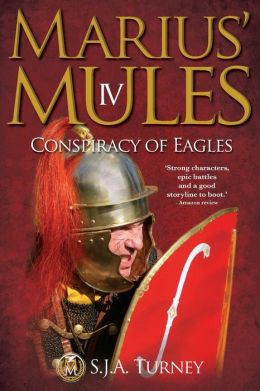
S.J.A. Turney - Marius' Mules IV: Conspiracy of Eagles, Victrix Books, 2013

After catching my attention with the first book in the series, finding his feet and going all out with some wonderful battle scenes in the second and then rounding the story up with more of the same plus an in-depth exploration of characters and background stories in a peaking third book, I thought the fourth book drops the standard a little bit. After all, Caesar's fourth year in Gaul makes for some great reading, epic scenes and much of the world history being made: first advent of an organized Roman force North of the Rhine, first Roman military expedition to the British Isles and the year in which Trans-alpine Gaul is referred to as a Roman province in Rome. So naturally, I expected Conspiracy of Eagles to flesh all of these out. Instead of sticking to the beaten track, Simon makes some very unexpected choices.

The last book, Gallia Invicta, already saw two of everyone's favourite Romans, Lucius Vorenus and Titus Pullo, given less space than even Caesar in his concise reports thought necessary, and that was unexpected. Understandable though, as probably Simon did not want to delve into similar story lines with HBO series' Rome. But with Conspiracy of Eagles, most of my guesses about the focal points of the book have gone astray. Crossing of the Rhine, and the magnificent bridge Caesar was so proud of that he took the time to describe in detail the building process? Rather briefly dismissed by Simon, who instead takes Fronto across on a different route and would have probably made him conquer Germania all by himself, had Caesar not decided to leave quickly. Attack on the British Isles? Hmm, this was a tricky one. No character, not even Julius Caesar, the man who stood in front of Alexander's statue and measured his achievements against the great warrior's, have any sense of history or majesty, which would be the first thing in my mind. With a visible affection for his native land, Simon opts for a very tongue in cheek description of the South East coast, one that - although entirely accurate and well documented - has become the funniest cliche I've ever encountered: while in Spain the rain falls mostly on the plain, in Britain the rain falls everywhere, all the time. So much so that there are numerous words in English referring to rain that a language like Italian has an awful time translating. I remembered reading the letters of Roman legionaries in Britain at the British Museum, most of which were full of complaints about the weather and requests for warmer clothes, and that sentiment was fully echoed here.

There is some more attention paid to this first, largely unsuccessful incursion in England, but the focus is always some place else. While the battle scenes are as gripping as ever, the reader's main focus goes back to an intricate web of conspiracies, politics and personal dramas that puts Britain in the background. I expected Simon to put all the blame for the ill-planned expedition at Caesar's feet, but in hindsight it would have been all too easy.

And then finally, in the last few chapters of the book, I surrendered to the idea that this is no longer a historical novel but rather a policier set in ancient Rome. As soon as I did that, the book appeared in a very different light, and Simon proved (once again) to be as masterful a writer with criminal investigations and espionage as he is with battles and sieges. The cherry on the cake is a plot twist at the very end of the book that only left me wanting for more. Luckily, there is more and this time I will expect nothing from the fifth book. No druids, war chariots or pict archers, no masterclass in sailing from one of the few glorious chapters of triumph at sea in Roman history and no expectation from Caesar whatsoever. I have obviously grown very fond of Fabius and Furio (although I still can't really make them apart), so naturally I'd like to hear more of them. Not very sure I will though.

And then there are some big questions that lie in waiting to which probably Simon only has a sketch of an answer as of yet: what of the Civil War? Will a married Fronto be willing to carry on fighting? Moreover, will he be still supporting Caesar when he takes on Rome? What of Labienus, of which we know for sure fought for Pompei? At which point the rift between him and the general will pass the point of no return? Will death, from which Fronto has escaped so many times, finalli find him on the battlefield, or will he see off his days in the warm sun of Southern Italy? Well, there's three more years of campaigning before we get any closer to the answer.

Some web reviews of Marius' Mules seem to protest against the modern elements in the language. I have raised this point in my review of the first book. Some of it is justified (yes, to bury the hatchet is a expression gifted, together with the Americas, by the pre-Columbian natives and yes, the language does put the novels in a modern context, enabling readers of the future to easily identify the time of writing), but none of it matters for the author's enterprise. The series still stands as an amazing introduction to the Roman world and to a series of legendary figures of heroes and super-heroes who have the capes and the money, but lack the batmobiles, extraterrestrial birth or gene changing accident. I am more concerned about reintroducing the characters each time they appear in a book by their deeds and achievements in the previous books. It gives the series one of the most disturbing traits in the TV documentaries of today: the assumption that the audience are too dumb to follow a point if it's not stressed every ten minutes and that they need to be reminded about the matter at hand after each advertisement break, because they all have the attention span of a goldfish.

One historical point to address: there are a number of references to the wolf standard as symbol of the cavalry. I have raised this point to Simon and luckily he said they stem not from historical references but from personal preference. Which was fortunate for me because it spared me hours of re-reading of sources. As a Romanian, I hold the wolf standard as an important symbol and take some pride in the fact it was adopted by the Roman cavalry after the conquest of Dacia. While it is not exclusively a Dacian symbol, there is no record of its official use in the Roman army before the second century after the Empire.

And a quote I particularly liked: "It [politics] won't bother you, I suppose. You've been given a sword and pointed at a barbarian." says Fronto to the two centurions in the discussion on the beach. This resembles another favourite quote of mine, written by Antony Minghella for WP Inman, the Civil War soldier who says he's been sent to war, like countless others, with a lie and a flag. Both phrases echo a larger truth, the fact that wars are essentially useless, a horror for soldiers and civilians alike, from which a handful of political heads profit. But, gosh, there is something so terribly attractive about wearing a sword and a shield!

vineri, 20 februarie 2015

Title is half the story

S.J.A. Turney - Marius' Mules III: Gallia Invicta, Victrix Books, 2013

This third book of the Marius' Mules series follows the deeds of Julius Caesar and his army in the third year of his governorship in Gaul. While Fronto is still our main character, this book breaks away from the character-centered style of the first two titles and we see other notable figures in the legions getting more pages than we were used to.

Determined partially by Caesar's approach to the year's campaigning, the story follows alternatively the three army bodies the general split his legions into. Another factor in this decision is a visible change in approach from the author's part. In an attempt to make it a more complex novel, Simon expands his narrative threads thus adding a complexity to the book that  - to my mind - makes it the best in the series so far,

Everything I've been complaining about in the previous title is corrected: new ways of advancing the story are explored (such as letters or dialogue covering the action, rather than simple description), we get characters that become at least as likeable as Fronto (hails for Galba, legate of the XII and centurion Cantorix of the XIV) while everyone's favourite legate indulges in so many binge drinking episodes that they scratch the shiny image of his perfection. And, a personal favourite, we get the introspections, the looks inside characters mind. Remarkable in this regard is the story of tribune Rusca of Legio VII, introduced as a green aspiring politician with no battle experience and his transformation into a hardened soldier over a very short, but very intense period.

But the cherry on the cake is the transformation of Crassus. While hints were dropped in the previous book, it is here that Simon gives a masterclass in portraying a character. Young Crassus is still arrogant, harsh and sometimes reckless, but we get to see his redeeming features as well: he can admit to his own mistakes, he can conceive a winning strategy and motivate his soldiers to follow him into danger. Crassus ceases to be a human feature under the appearance of a human being and becomes a real person, with merits and faults. His evolution is so immense that the end of the book even catches glimpses of a bond and sympathy between him and Fronto.

The sieges, skirmishes, ambushes and full blown battles are still there and while voices might say they become routinely and boring after a while, I did not for a second thought it was the case. Not only are they so imaginative that one can only admire the huge documentation and thought process involved in creating them, but Simon also knows how to alternate these gory, grisly battle scenes with non-fighting intrigue that none of them becomes suffocating for the reader.

Another novelty, the book is framed by political intrigues in Rome, with Fronto at their very center. I am not the biggest fan of these chapters and it is my impression that Rome is best served, in fiction at least, by characters like Fronto or Maximus the gladiator who fight for its glory without ever witnessing its putrefaction. But I do understand Simon's enterprise and his attempt to understand the deeper motivations of the historical figures, beyond their military actions.

There are a lot of episodes I've fallen in love with in the same manner I was falling in love with the tales of heroic deeds in the stories of my childhood: Galba's escape from Octodurus, Cantorix's antics at Crociatonum, Atenos' calculated madness in the naval confrontation with the Venetii or Fronto's bath engagement with the two gladiators.

I do not fully understand Galronus' position and attitude for, while he is theoretically a hostage and representative of a people under very recent Roman occupation, he acts and talks entirely Roman. But I will let that pass as artistic licence. And there's another bit in which I think I disagree with the writer: while I do think that the Romans had a sense of entitlement and duty to take "civilisation" to "barbarians" in a manner not dissimilar to the USA today or the British Empire in the 19th century, I doubt the conquered people were so eager to admit the superiority and merits of Roman "civilisation". It makes in fact little sense that the very people that were fighting the Romans the year before would become trading partners over the course of a winter. Or that the Menapii would be convinced to drop their weapons, quit the fighting and return to the fields by a speech.

But Simon, just like Julius Caesar or Fronto, belongs to a people whose military might authorizes them to think of their civilisation as superior to the conquered ones. And, when I add to the mix the notorious Saxon ignorance when it comes to other cultures, I realize Simon actually does a great job where a lesser writer would be way out of his depth.

I am going to close this review by reiterating the feeling that my words do not really convey how much I've actually enjoyed the book and there's probably no potential cover quote in what I've said. But to any Roman Empire aficionado, this one's a must read. And anyway, if you've come near the MM series, you'll find it very difficult not to sink in.