vineri, 20 februarie 2015

Title is half the story

S.J.A. Turney - Marius' Mules III: Gallia Invicta, Victrix Books, 2013

This third book of the Marius' Mules series follows the deeds of Julius Caesar and his army in the third year of his governorship in Gaul. While Fronto is still our main character, this book breaks away from the character-centered style of the first two titles and we see other notable figures in the legions getting more pages than we were used to.

Determined partially by Caesar's approach to the year's campaigning, the story follows alternatively the three army bodies the general split his legions into. Another factor in this decision is a visible change in approach from the author's part. In an attempt to make it a more complex novel, Simon expands his narrative threads thus adding a complexity to the book that  - to my mind - makes it the best in the series so far,

Everything I've been complaining about in the previous title is corrected: new ways of advancing the story are explored (such as letters or dialogue covering the action, rather than simple description), we get characters that become at least as likeable as Fronto (hails for Galba, legate of the XII and centurion Cantorix of the XIV) while everyone's favourite legate indulges in so many binge drinking episodes that they scratch the shiny image of his perfection. And, a personal favourite, we get the introspections, the looks inside characters mind. Remarkable in this regard is the story of tribune Rusca of Legio VII, introduced as a green aspiring politician with no battle experience and his transformation into a hardened soldier over a very short, but very intense period.

But the cherry on the cake is the transformation of Crassus. While hints were dropped in the previous book, it is here that Simon gives a masterclass in portraying a character. Young Crassus is still arrogant, harsh and sometimes reckless, but we get to see his redeeming features as well: he can admit to his own mistakes, he can conceive a winning strategy and motivate his soldiers to follow him into danger. Crassus ceases to be a human feature under the appearance of a human being and becomes a real person, with merits and faults. His evolution is so immense that the end of the book even catches glimpses of a bond and sympathy between him and Fronto.

The sieges, skirmishes, ambushes and full blown battles are still there and while voices might say they become routinely and boring after a while, I did not for a second thought it was the case. Not only are they so imaginative that one can only admire the huge documentation and thought process involved in creating them, but Simon also knows how to alternate these gory, grisly battle scenes with non-fighting intrigue that none of them becomes suffocating for the reader.

Another novelty, the book is framed by political intrigues in Rome, with Fronto at their very center. I am not the biggest fan of these chapters and it is my impression that Rome is best served, in fiction at least, by characters like Fronto or Maximus the gladiator who fight for its glory without ever witnessing its putrefaction. But I do understand Simon's enterprise and his attempt to understand the deeper motivations of the historical figures, beyond their military actions.

There are a lot of episodes I've fallen in love with in the same manner I was falling in love with the tales of heroic deeds in the stories of my childhood: Galba's escape from Octodurus, Cantorix's antics at Crociatonum, Atenos' calculated madness in the naval confrontation with the Venetii or Fronto's bath engagement with the two gladiators.

I do not fully understand Galronus' position and attitude for, while he is theoretically a hostage and representative of a people under very recent Roman occupation, he acts and talks entirely Roman. But I will let that pass as artistic licence. And there's another bit in which I think I disagree with the writer: while I do think that the Romans had a sense of entitlement and duty to take "civilisation" to "barbarians" in a manner not dissimilar to the USA today or the British Empire in the 19th century, I doubt the conquered people were so eager to admit the superiority and merits of Roman "civilisation". It makes in fact little sense that the very people that were fighting the Romans the year before would become trading partners over the course of a winter. Or that the Menapii would be convinced to drop their weapons, quit the fighting and return to the fields by a speech.

But Simon, just like Julius Caesar or Fronto, belongs to a people whose military might authorizes them to think of their civilisation as superior to the conquered ones. And, when I add to the mix the notorious Saxon ignorance when it comes to other cultures, I realize Simon actually does a great job where a lesser writer would be way out of his depth.

I am going to close this review by reiterating the feeling that my words do not really convey how much I've actually enjoyed the book and there's probably no potential cover quote in what I've said. But to any Roman Empire aficionado, this one's a must read. And anyway, if you've come near the MM series, you'll find it very difficult not to sink in.

vineri, 30 ianuarie 2015

Battle of Wits

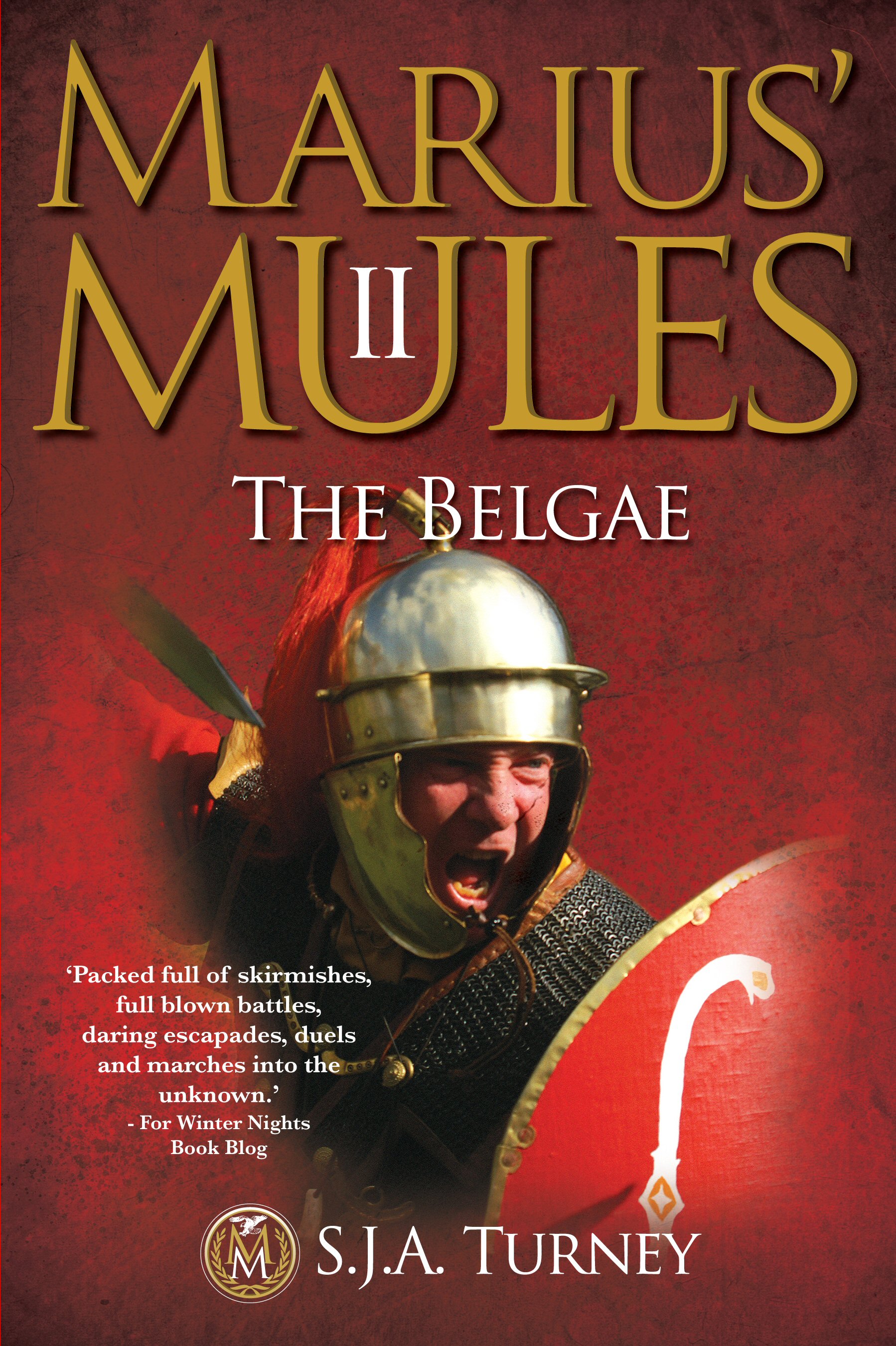
S.J.A. Turney - Marius' Mules II: The Belgae, Victrix Books, 2013

For all the suspicions I started reading this series with, I am now racing through it and I am, at the time of writing, already a quarter into the third book. So what was the second all about then? Well, the Belgae. Of which we know, from Julius Caesar, they inhabit one of the three parts of Gaul, the other two being occupied by Aquitani, in the south-west, and the Gauls, all over the place. Of course, Caesar conveniently forgets about Gallia Narbonensis, which - although geographically very much a part of Gaul - was Roman territory for two generations already when he wrote De Bello Gallico.

And in the spring of 57 BC, unhappy with the last third of Caesar's famous motto Veni, Vidi, Vici, the Belgae found themselves at the heart of a revolt against the forces of Rome camped in Gaul and a little too close for comfort over the winter. These are the premises from which both Caesar's second book on Gaul and Simon's novel start. This time, however, Simon takes some bolder decisions than in the first book of the series and goes astray from the general's letter a lot more and a lot more often.

It is, undoubtedly, a much more spectacular book. The very notable siege of Bibrax, together with the events and the dialogue that frame it, is masterful writing. The difference between the previous year's campaign and this one is this time Caesar's legions are fighting an unknown opponent that is, however, very aware of their opponents' might and tactics. Almost the opposite of the confrontations with the Helvetii and Aristovius' Germans. If exploited well - and Simon does exploit it well - this historical context makes for fascinating literature. Not only does the battle of mights becomes a battle of wits a lot of the time, but the drama delves into some episodes of espionage and intelligence gathering as well, with Priscus (but not only) becoming an ad-hoc James Bond.

And of course, this is war, not a board game. Whenever one of the opponents is outsmarted, there is loss of life. In this respect one could say that the book is too gory and yes, probably the faint-hearted would best be staying away but then, what business have the faint hearted reading war novels anyway?

What I find interesting is noting how, simultaneously with displaying his impressive documentation and imaginative power when it comes to military strategy, Simon also shows the limits of his writing. His is not the deep introspective novel. Psychological conflicts and the great philosophical questions hidden under the mask of dialogue are not for him. All his characters are very uni-dimensional, almost flat. Fronto will always be a socialist, outspoken to a fault, notorious drunkard and a great military mind. An advocate for peace and a brilliant war-maker, at the same time condemning and provoking loss of life.

And for some reason Simon chose Crassus to be his villain. The young patrician is the absolute worst, all his decisions are bad and he can do no right by Simon, apparently. Although I have learned by now that this may not be exclusively for portrayal purposes, but also for some other intrigue that will be unveiled a few books ahead. Because this is another thing that happens in Marius' Mules, action threads are opened and then forgotten about, only to resurface some time later (in some cases a very long time later, as will probably happen with Paetus, the camp prefect who wants to kill Caesar, but will see his wish come true only 13 years later).

This book is part of a long saga and, as with all long sagas, we say hello to new characters and goodbye to others. I don't want to spoil any surprises, but I would advise you not to become too emotionally attached to anyone in the Tenth Legion. Or the Twelfth.

And if, like me, you have read De Bello Gallico and have been left in awe of how big Titus Labienus' contribution was to the successful conclusion of the Gallic Wars, you were wrong: it was all Fronto.

Quotes, for long winter nights:

"Rome is not a city; it is an idea. An idea that encompasses all who let it. The tribes of the Alps or the southern coast have considered themselves part of that idea for generations now and they have wine, and aqueducts and theatres and arenas and..." [...] "and most of all, they have peace."

"we need to take, but we also wish to give. Not a conquest, but a partnership."

marți, 30 decembrie 2014

What a Friend we have in Jesus

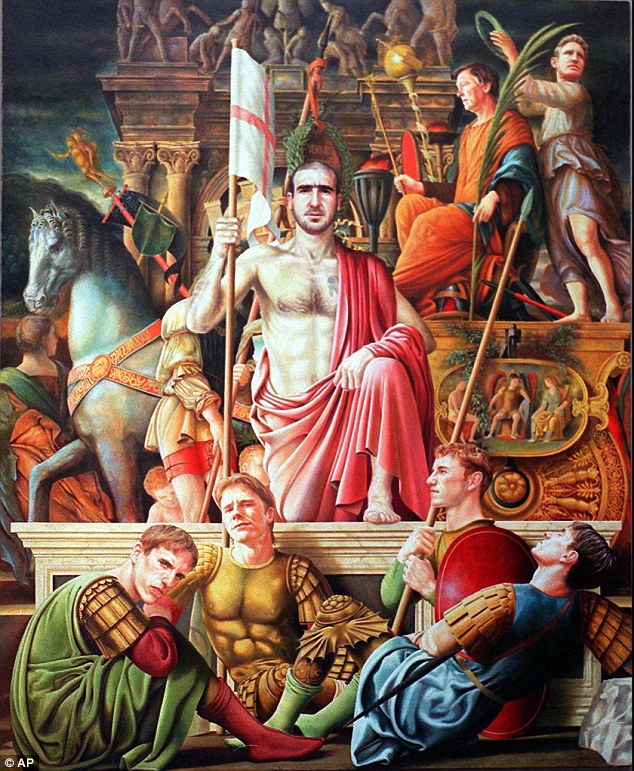
Philippe Auclair - CANTONA. THE REBEL WHO WOULD BE KING, Pan Books, London, 2010

It is with good reason that some readers deride sports biographies as being an inferior genre to 'proper' literature. Even sports fanatic readers. I believe it to some extent and it is right, to some extent. It would be extremely ignorant, however, not to be aware of the limitations of this fact. It would be even more ignorant to judge all the sports biographies/sports history books by the same measure. Nick Hornby's Fever Pitch immediately comes to mind to destroy all stereotypes. Yes, it is an account of following Arsenal for 20 years, thus coming under sports history genre, but it is so much more than that, with its brilliant writing, its humour and its psycho-sociological investigations to mention but a few qualities.

With a sports book it is very important to look at the context before looking at the content. First and foremost, motivation: why has it been written? Is it an attempt to provide an honest historical account, or is it solely a commercial enterprise? It is also easy enough to know. Of course books like The Secret Footballer or The Secret Diary of Mario Ballotelli are abusing the dedication and often the ignorance of the game's followers. Of course yearly catalogues, club magazines and official accounts are just PR exercises of self-aggrandisement. Likewise Wayne Rooney's My Story So Far written at the ripe age of 18 or Cristiano Ronaldo's Moments (just contemplate for a moment this thought - Cristiano Ronaldo, the writer). There's stuff like Cantona on Cantona or Rio Ferdinand's My Decade as a Red that prove that writing isn't even esential to a book - they contain next to none and are mere selections of pictures accompanied by quotes. All these make a lot of money in the process, and keep the huge football marketing beast fed.

But then, of course, there are the honest accounts, be they commercially motivated or not. Even then, they can fail miserably, when the author, former footballer, either: tries to resolve issues with his peers, takes all the writing upon himself without trusting a journalist or picks a bad journalist/writer. Easy example, Dwight Yorke's Born to Score, which checks the first two.

Sometimes, however, biographies turn out brilliantly. Although very naive in some respects and by now inadecquated, I think Duncan Edwards' Tackle Soccer This Way is a brilliant read. So is Denis Law's autobiography.

Thus, the best shots you have in picking football literature are biographies written by professional sports journalists of footballers whose careers ended at least a few years back. This is a sure-fire way to know the book is not exploiting the fame of the moment, as I'm sure there are currently enough of Messi's biographers not only to defeat Barcelona, but also to provide the public for that game. This is exactly what Phillipe Auclair's book is, but let me stress one more point before I get to it:

At the end of the day, it matters for nothing. A fan is a fan, and would buy anything. I would literally buy shit with United's crest on it, and figuratively speaking I have already. I paid double the price for a stupid collection of pictures containing Rio Ferdinand playing football just to have a copy signed by the man himself. Most of the books I mentioned above as being stupid, fake or commercial I have bought and read, in full knowledge they're either stupid, fake, commercial or a combination of these. Why? Well, too big a question for me to answer. But I will refer you back to Nick Hornby's book, he gives it a pretty damn good go.

I wanted to read Auclair's book on Cantona since it came out and it is with a feeling of guilt that I think I haven't done it so far. Did it teach me a lot, did it make me a better man, did it reveal me any secrets about the universe or the world we live in? Well, I know more about Cantona now, and I feel very content about this, although by most accounts I knew a lot more than is healthy about Cantona even before. The hell with it! What do they know? Let these naysayers go back to their world, we have football!


Strangely enough, however, I did not think it was a particularly great read. I mean... it's well written, well documented and for the most part very engaging. But to my mind, Auclair fails the most important challenge he set out on, granted, the most difficult one, too. He does not give a satisfactory explanation to what is it that makes Catona special. Obviously, Cantona is like no other footballer in a number of aspects. But why is he The King? Or The Saviour, on a par with Jesus himself in the eyes of Old Trafford faithful, and bigger than the advent of Christmas? With a mere 4 seasons played for United and no international trophy with club or country to his name, Cantona's figures are easily beaten by other players with peripheral roles in United's history. And for all the talk about the poetry of the game, inspiration and artistry, it is Cantona himself who says he talks a lot of rubbish. So we need to look elsewhere to discover the essence of Cantona's greatness, and this, I think, is what Phillipe Auclair doesn't do. He tries to explain the miracle by staying grounded, tries to prove what it only takes faith to be understood. Sounds too religious? We haven't even scratched the surface.

I like to tell people this about Cantona: 1992, Cantona is playing for Leeds, Leeds wins the title. 1993, Cantona is playing for United, United wins the title. 1995, Cantona is suspended for the second half of the season, United lose the title to Blackburn. Obviously, 1994, 1996, 1997, the other seasons Cantona spent in an United shirt, United won the title every time.

Interesting as his early life might be, and the interaction between him and the management legend that is Guy Roux is pretty interesting, these 4 years are the miracle of Cantona, and the moment he'll be remembered for, just like of Jesus' 33 years on earth, it is only the last few weeks that the Christians celebrate, completely ignoring the rest.

I didn't like how the lead to the Selhurst Park incident felt so much like a build up. Important as the kung fu kick might have been - and its importance is hugely inflated by the media, as was the punishment, it is by no means the defining moment of Cantona's United career. Hell, the press statement in the aftermath is more memorable.

Myself, I cannot reduce Cantona's time at United to less than it was. This was his defining moment, these 4 years and a half in which, with Cantona, United not only played so much better that they completed turned their fortunes around, but they set out on a path to greatness that is, at least so far, unstoppable (meanies, don't mention Moyes!). If anything, Ken Loach was closest to the truth, in Looking for Eric. "You have to trust your team mates", "My best moment was a pass", these are all part of the Cantona canon, and they set that model of imitatio Catona that United has been so successful in following.

So in Cantona's case, there is no point to go looking for the man behind the myth.


For Cantona the footballer was pure myth. And today, if it happens to accidentally meet Cantona, he is transfigured before us.


A child born on the day Cantona retired would be 17 today. But if that child would go to a Manchester United game, he's gonna sing and drink a drink to Eric the King.

"I'm so proud the fans still sing my name, but I fear tomorrow they will stop. I fear it because I love it. And everything you love, you fear you will lose." (Eric Daniel Pierre Cantona)

And quotes, because Cantona is an inexhaustible source of great quotes:

"It is better if it's not said but shown in other ways"
"And you can cry, even when you are a strong man. You can find something beautiful and simply cry because it is so beautiful. You can find emotion in the beauty of things and, to me, that's love."
"You see a lot of civil servants in football. This type of behaviour doesn't agree with me. I become bad"
"You need a lot of personality to accept putting yourself at the service of someone else. The creator doesn't exist without this tacit agreement."
"The problem is that England is very beautiful in may respects, but very ugly when it comes down to the image and to the press. It's unhealthy."(Eric Cantona)

"In football, yesterday happened a long time ago" (Billy Bremmer)

"For that money? Has he lost a leg or something?" (Brian Kidd upon news of Cantona's £1M transfer from Leeds)

"I'm so glad to meet the second most famous Frenchman in Britain" (Speaker of the House of Commons Betty Boothroyd greeting French president Jacques Chirac)

29: Justice is an instinct, not a rulebook. No rules should circumvent invention. Those who have the ability to imagine beyond the rules have a right, maybe a duty, to break them, and damn the consequences.

155: You only used your voice when you had failed to share information and feelings in a different, more profound way - instinctively, by exchanging a look, or by passing a ball.

317: Federer's astonishing exploration of his gift is a selfish enterprise, an attempt to fins the answer to this question: how far can I go? But because this adventurous impulse takes place in a public arena, it becomes almost a gift to others.

sâmbătă, 27 decembrie 2014

Cowboys and gays

Dallas Buyers Club (USA, 2013), Directed by Jean-Marc Valée

In the age of CGI monsters and graphic novel superhero movies, it is refreshing to see that one can still make an exceptionally good movie with a $5M budget, and be rewarded with a few Oscars for it.

Dallas Buyers club has started at the point that any movie is supposed to start: a good story. The complexity of the main character and the very peculiar string of events makes it very unlikely for such a wonderful story to be completely made up, although I'd sure as hell watch every movie of the writer that could. The fact that is based on real events, like in most cases, neither adds nor retracts anything from the merits of the movie.

To me, the outstanding aspect of this feature, is the unusual ethical complexity of the main character. We are faced with a guy who passes as pretty regular amongst his peers and a complete product of his environment. To most viewers' standards, I guess he's rather unlikeable. And the good thing is, the movie does not try to make him any more likeable. It is a great directorial ability, to tell a story entirely made of facts, leaving all judgements to the audience. And it is interesting to see how, although staying true to himself, the character of Ron Woodroof undergoes a massive transformation.

His homophobia and his exclusively pecuniary motivations are shattered and in the course of his journey we discover his humanity coming out in full bloom from deep beneath multiple layers of social prejudice. And if it was for this aspect only, the movie would still be very good. But the story touches on a much greater number of ethically grey social aspects: the prejudices linking homosexuality with AIDS in the 80s and 90s, the interests of the pharmaceutical industry confronted with the interests of their clients, regulation of food and drugs and the fairness of outcasting or outlawing the unorthodox elements that dare to think outside the box.

It is how far outside the box Ron Woodroof dares to think that drives the story forward, and his ingenuity in always finding regulation loopholes is a big part of what drives the story forward. Funny how the producers chose a Canadian director for a movie that makes the FDA look so bad, thus completely fulfilling the cliché of horrible health care in the US. It is also scary to think that American directors would actually hesitate to take on the topic.

Quite a few memorable scenes in the movie, from the one when Ron forces his homophobic fried to shake his cross-dressing homosexual partner's hand to the one that nearly brought me to tears of the old homosexual couple donating their house to a cause that started as a profit driven enterprise and became the only hope of many hopeless cases. It is the reverse journey of the pharmaceutical industry and it shows the dangers of not including an ethical element in the development of commercial products.

I'm not entirely sure if Matthew McConaughey's performance is exceptionally good, or if it's just the weight loss and the make-up. He's rather hard to recognize, if that's any worth. And his posture and accent place him right in the heart of Texas, just like the character he's embodying, although this might actually be the merit of the casting director. I am sure he deserved his Oscar ahead of Christian Bale's American Hustle, although I'm curious to see what Bale would have made of this part.

I'm not a big fan of Jennifer Garner and this movie doesn't help her cause. She's good, granted, but she benefits from an exceptionally well written part.

Jared Leto is, I think, the revelation of the movie. I thought everything we feel for the character is entirely down to his acting. And by no means I would have expected this from him, the pretty boy with a pop star image playing Alexander the Great's sexual partner.

Griffin Dunne's Dr. Vass is a very interesting part and I would have loved to see it developed a bit more, especially in terms of motivation and awareness of own impact.

So that's my take on a movie I felt a strong urge to write about, most likely because of its ethical implications. Great story, great writing, great directing and quite possibly Matthew McCounaughey's best role so far. And despite his best effort in both, this movie is so much better than Interstellar it defies comparison. Possibly because it doesn't rely on expensive CGI. And it's 2D.

vineri, 28 noiembrie 2014

De Bello Caesarii


Din cand in cand, eu scriu recenzii de carti. Din cand in cand insa, citesc carti atat de adanc patrunse in constiinta universala incat e teribil de greu sa vorbesti despre ele pentru ca, printre altele, carti despre acele carti au devenit clasice. Fara indoiala, De Bello Gallico e una din cele mai importante scrieri ale umanitatii, citata la tot pasul si omniprezenta in studiul antichitatii, beneficiara a mai multor tone de literatura secundara si prima scriere prezentata studentilor limbii latine. Foarte posibil, cea mai importanta scriere in latina de care avem cunostinta astazi (Eneida poate prezenta un argument bun, dar interesul pentru Eneida este cu precadere filologic si in secundar istoric, or De Bello Gallico e citat de o intreaga serie de alte stiinte sociale, printre care antropologia si sociologia cele mai importante). Si asta pentru ca e scrisa de unul din cei mai importanti vorbitori de limba latina care au trait vreodata.

Caius Julius Caesar (100-44 i.Ch.)
Cine a fost Caius Iulius Caesar? Intrebarea asta nu poate avea un raspuns simplu, doar unul simplist. Iar unul simplist o sa dau si eu, printr-o biografie succinta: nascut in 100 i.Ch. intr-o familie influenta din Roma, Caesar ajunge la 15 ani, dupa moartea tatalui sau, capul unei familii nevoita sa se implice in disputa dintre Gaius Marius si Cornelius Sulla. Facandu-si un dusman din Sulla, Caesar nu si-a mai permis sa stea in Roma pana la moartea acestuia, in 78 i.Ch. Intors in Roma isi incepe ascensiunea in politica ajungand, in 63 i.Ch., Pontifex Maximus - cea mai inalta functie clericala. De aici urmeaza 3 ani de guvernare in Hispania Romana, timp in care Caesar reuseste sa scape de suficient de multe datorii incat sa poata candida pentru functia de consul, cea mai importanta pozitie din Republica Romana. La sfarsitul anului consular, in 58 i.Ch., Caesar este delegat guvernator al Galiei Cisalpine, moment in care incep actiunile descrise in De Bello Gallico.

Toate datele ramase despre el il prezinta pe Caesar ca un politician corupt, un individ inglodat in datorii colosale si care cauta in permanenta protectia unei functii politice pentru a nu da socoteala in fata legii si in general un om de moravuri cel putin indoielnice. Primul portret serios al lui Caesar cu care am intrat in contact, cel al lui Dumas, nu e nici el prea magulitor. Istoria l-a judecat si va continua sa-l judece pe Caesar in fel si chip, de multe ori in functie de interesul politic al zilei. Dar realizarile si impactul asupra istoriei pe care l-a avut Caesar depasesc interesele oricarui moment politic, fie el si apogeul republicii romane. Si pentru un individ de buna credinta, toata treaba asta e putin confuza. Manat fara indoiala de ambitie si interese indeobste pecuniare, Caesar, ca si Alexandru, se dovedeste un strateg stralucit, ceea ce il face anti-eroul istoric perfect. Si e greu sa nu iubesti un anti-erou bun.

Ce a fost Caius Iulius Caesar? Si asta e un raspuns foarte greu. Politician si om de stat, categoric. Consul, in cel putin doua randuri. Dictator in mai multe randuri, dar a schimbat incontinuu definitia cuvantului. Guvernator, dar din postura asta s-a facut cunoscut mai degraba ca general, apelativ pe care cele 12 legiuni pe care le va avea pana la urma in subordine il foloseau. Scriitor, pentru ca a scris. Iar felul in care scrie si scopurile in care ii sunt citate scrierile ii pot pune o serie de etichete extrase, din nou, din stiintele sociale (antropolog, ganditor, istoric, explorator etc.). Iar felul in care a folosit banii (in special ai altora) in Roma, ii poate aduce o alta serie de etichete, imprumutate de data asta din viata economica (producator de evenimente, antreprenor etc.).

Din punctul meu de vedere, omul a excelat in multele domenii in care si-a propus sa activeze. Foarte probabil in toate. Sunt tentat sa spun ca o asemenea capacitate si asemenea energii ar fi fost demne de a fi puse in slujba unor scopuri mai nobile, dar cu ce drept pot eu sa-i judec scopurile lui Caesar? Eu ma bucur si ii sunt recunoscator pentru cartea asta, o lectura peste masura de educativa si extrem de placuta in egala masura. Si inteleg ca e posibil ca Vercingetorix sa nu-l fi placut la fel de tare.

Am vrut sa citesc De Bello Gallico dupa ce am citit excelenta fictionalizare a lui Simon Turney. Iar acum, De Bello Gallico m-a facut sa vreau sa grabesc lecturile si sa nu-mi mai aman Suetoniusii, Plutarhii si Gibbonii prea mult. Inca 7 carti din ciclul Marius' Mules (plus 8 in curs de scriere), 4 din ciclul otoman si proiectul meu despre istoria Angliei care trebuie terminat. Imediat, asadar.

Editia pe care am citit-o e digitala, contine cele 8 carti ale De Bello Gallico si pe cele 3 ale De Bello Civili, e in engleza si a fost publicata prima data in 1915. Ceea ce e interesant, pentru ca mai adauga un strat de anacronism lecturii. In secolul care a trecut de atunci limba si limbajul s-au schimbat, Britannia a pierdut un ditamai imperiul, cele mai mari doua imperii din Europa, cel Austriac si cel Otoman, au disparut si harta lumii s-a transformat radical. Ceea ce nu pare prea important, pana cand incepi sa incerci sa descifrezi unde anume este Caesar la un moment dat, avand in vedere ca s-a miscat in tot bazinul mediteranean, intre Germania si Sahara si intre Britannia si Iran, iar cu scrisul acopera o suprafata usor extinsa. Am ales editia asta pur si simplu pentru ca a fost cea mai usor de gasit editie completa. Bonusuri, o introducere a lui Thomas de Quincey si un index interesant prin aceea ca arata de cel fel de explicatii aveau nevoie cititorii inceputului de secol 20 (Italia, de exemplu, e una din cele mai cunoscute tari din Europa, stiati?). Am incercat, in paralel, sa confrunt cu o editie in latina, dar mi-am dat seama ca pentru a citi De Bello Gallico in latina am nevoie de mult mai mult timp si mult mai multa rabdare decat sunt dispus sa-i acord in momentul asta, asa ca am ajuns sa ma refer foarte, foarte sporadic la editia in latina, cu toata ca mi se pare ca limba latina are o anumita poezie interna si este, din punctul asta de vedere, mult mai placuta decat engleza.

Cunoscandu-i acum continutul, as zice ca cea mai buna utilizare a cartii este aceea de referinta. Pentru ca in ziua de astazi nici un cercetator serios nu o sa-si poata permite sa studieze toate momentele si toate locurile prin care Caesar a trecut in cei 10 ani de guvernorat in Gallia si cei doi de razboi civil, e buna o lectura prealabila pentru ca mai apoi sa ne intoarcem la scrierea lui Caesar ori de cate ori aprofundam un anumit aspect al perioadei. Pentru ca Caesar e foarte generos in a furniza toponimii, amplasari, distributii si miscari ale triburilor de pe un teritoriu ceva mai extins decat la Frantei de astazi, obiceiuri sociale, culinare, vestimentare si militare (in special militare) ale acestor triburi, descrieri geografice, printre care si o foarte interesanta trecere in revista a principalei faune care popula Padurea Neagra - intinsa in acea vreme, dupa spusele lui Caesar, de-a lungul intregului arc alpino-carpatic. Aflam foarte multe si despre romani: despre miscarile politice din Roma, despre organizarea militara romana, despre echipamentul roman, despre artileria romana si despre impresionantele lucrari de inginerie romana (dintre care mie mi-a stat mintea la acel pod peste Rin suficient de solid incat sa-l foloseasca masiv 60.000 de oameni, construit in ceva mai putin de doua saptamani si daramat din interese strategice la vreo doua luni dupa). Caesar ne spune si nume si povesti ale unor oameni care in mod normal n-ar lasa prea multe urme in istorie. Cu siguranta a urmarit sa-si faca scrierea placuta si accesibila, batranul pezevenghi. Spune si cifre, chiar abuzeaza in a ne prezenta sume de trupe. Dar stim pana la ora asta ca cifrele nu sunt foarte credibile si ca erau, la vremea scrierii, cel mai puternic instrument de propaganda. De exemplu, daca ne luam dupa Caesar, in batalia de la Alesia cele 12 legiuni romane numarand aproximativ 60.000 de oameni forta combatanta au asediat 80.000 de luptatori gali in cetatea Alesiei si au respins o forta de sustinere din exterior de 320.000 de oameni. Va imaginati cum arata 450.000 de oamni angajati in lupta corp la corp?

Suntem obisnuiti ca romanii sa lupte in inferioritate numerica masiva (generalul Suetonius cu aproximativ 10.000 de oameni in doua legiuni invinge la Watling Street o armata a Boudicai estimata la 230.000 de oameni), dar e foarte posibil ca de fiecare data cifrele sa fie umflate de propaganda. Si cam cat de mult trebuie sa fi mancat cei 60.000 de oameni ai celor 12 legiuni, si cam cat de dificil o fi fost sa se transporte mancarea pentru ei din loc in loc, dat fiind faptul ca una din cele mai eficiente metode folosite de Caesar a fost ultra-mobilitatea trupelor lui, indiferednt de sezon si de teren? Si de multe ori Caesar vorbeste despre cat de dificil era sa asigure hrana unei armate atat de imense intr-un teritoriu ostil in care adversarul incerca din raspunteri sa impiedice colectarea hranei si sa distruga convoaiele care o transportau. Iar felul in care de multe ori isi forteaza norocul ma face sa cred ca Caesar era un mare parior. Zeita Fortuna i-a zambit destul de mult timp, inclusiv in momente cand a fost la un pas de dezastru, ca la esecul de la Gergovia sau in batalia de la Dyrrachium si nu pot sa nu ma intreb, cum de un om cu o asa buna viziune asupra evenimentelor ca Julius Caesar a lasat sa-i scape complotul de la Idele lui Marte din 44 i.Ch.? Cred ca ori era, pana la acea ora, atat de deconectat de realitate si orbit de puterea pe care i-au dat-o realizarile anterioare incat se credea invincibil, ori pur si simplu a vrut sa se inchipuie un al doilea Sulla care, odata ce a renuntat la funtia de dictator pe viata, si-a concediat lictorii si se plimba nepazit prin mijlocul poporului.

Fiecare campanie a lui Caesar si fiecare batalie e fascninata in felul ei si merita comentata si analizata indelung. Dar inainte de asta, e foarte important pentru cei interesati de subiect sa cunoasca la prima mana textul lui Caesar; fie si pentru a vedea in ce fel i-au deturnat sensul cei care ne-au invatat istorie. Pentru ca o covarsitoare majoritate a informatiilor pe care le avem despre campaniile lui Caesar le avem de la Caesar insusi. Si, in ciuda intereselor politice pe care le-a avut, mi-e greu sa cred - mai ales gandindu-ma si la stilul scriiturii, ca batranul vulpoi nu a avut in vedere si posteritatea cand si-a asternut ispravile pe tablite de ceara si pe piei de vitel. Si posteritatea numelui lui, cu siguranta, dar si - pur si simplu - dorinta sincera si dezinteresata de a tine generatiile viitoare informate cu privire la faptele lui. O socoteala in fata Zeului - care o fi el - in care si marele Caesar credea chiar, poate, fara s-o stie.

Citate:

"it generally occurs to most men, that, in their dependence on writing, they relax their diligence in learning thoroughly, and their employment of the memory" (DBG, Book 6, Chapter 14)

"There is an ox of the shape of a stag, between whose ears a horn rises from the middle of the forehead, higher and straighter than those horns which are known to us. From the top of this, branches, like palms, stretch out a considerable distance. The shape of the female and of the male is the, same; the appearance and the size of the horns is the same." (DBG, B6, C26) - 10 puncte pentru cine ma lamureste ce animal e asta.

"as much as he admired the greatness of their courage, since neither the fortifications of the camp, nor the height of the mountain, nor the wall of the town could retard them; in the same degree he censured their licentiousness and arrogance, because they thought that they knew more than their general concerning victory, and the issue of actions: and that he required in his soldiers forbearance and self-command, not less than valor and magnanimity." (DBG, B7, C52)

"no composition was ever executed with so great care, that it is not exceeded in elegance by these Commentaries" (DBG, B8, C0)

"we have more reason to be surprised than other men; for they can only appreciate the elegance and correctness with which he finished them, while we know with what ease and expedition. Caesar possessed not only an uncommon flow of language and elegance of style, but also a thorough knowledge of the method of conveying his ideas." (DBG, B8, C0)

"we listen with a different degree of attention to those things which strike us with admiration by their novelty, and those which we design to attest to posterity" (DBG, B8, C0)

"Why should he hazard the loss of any of his men, even in a successful battle? Why should he expose soldiers to be wounded, who had deserved so well of him? Why, in short, should he tempt fortune? Especially when it was as much a general's duty to conquer by tactics as by the sword." (DBC, B1, C72) - Caesar inaintea unei batalii pe care vroia sa o castige fara lupta

"experience is the best master in every thing on which the wit of man is employed" (DBC, B2, C8)

"what we wish we readily give credit to, and what we think ourselves, we hope is the opinion of other men" (DBC, B2, C27)

"I shall not boast of my services to you, which still are inferior to my own wishes or your
expectations." (DBC, B2, C33)

"He likewise restored to their former condition (the praetors and tribunes, first submitting the question to the people) some persons condemned for bribery at the elections, by virtue of Pompey's law, at the time when Pompey kept his legions quartered in the city (these trials were finished in a single day, one judge hearing the merits, and another pronouncing the sentences), because they had offered their service to him in the beginning of the civil war, if he chose to accept them; setting the same value on them as if he had accepted them, because they had put themselves in his power. For he had determined that they ought to be restored rather by the judgment of the people than appear admitted to it by his bounty: that he might neither appear ungrateful in repaying an obligation, nor arrogant in depriving the people of their prerogative of exercising this bounty." (DBC, B3, C1) - despre politica in Roma si in lume

"this was the only time to treat for peace; when each had confidence in his own strength, and both seemed on an equal footing. Since, if fortune showed ever so little favor to either, he who thought himself superior, would not submit to terms of accommodation; nor would be content with an equal division, when he might expect to obtain the whole." (DBC, B3, C10)

"if all their attempts were not crowned with success, the defects of Fortune must be supplied by industry; and whatever loss had been sustained, ought to be attributed rather to her caprices than to any faults in him" (DBC, B3, C73)

"there is a certain impetuosity of spirit and an alacrity implanted by nature in the hearts of all men, which is inflamed by a desire to meet the foe. This a general should endeavor not to repress, but to increase; nor was it a vain institution of our ancestors, that the trumpets should sound on all sides, and a general shout be raised; by which they imagined that the enemy were struck with terror, and their own army inspired with courage." (DBC, B3, C92)

vineri, 7 noiembrie 2014

Safety in numbers

S.J.A. Turney - Marius' Mules VII: The Great Revolt, Victrix Books, 2014

Photo credit link
Reading the first book in the MM series has triggered a series of events that has re-ignited my passion for the Roman world possibly stronger than it ever was before. I have read Caesar's De Bello Gallico in its entirety and had a bite of De Bello Civili, enough to realise that the HBO series Rome, which I recently started watching, is a rather close to the letter fictionalization of Caesar's account. I did not finish the great man's commentaries as Simon sent me MM7 one week before its official launch. Honoured and humbled by the gesture, I have made it my mission to read and review the book in time for the launch. Being the behemoth of a book that it is, I have failed, but I hope this review of mine will still serve some marketing purpose. Hence, here's my two cents:

Let me start with a huge spoiler: Caesar has won the war on Gauls. The readers that don't know that are very lucky, as they will have on their hands a very tense historical novel, whose conclusion hangs on a thread up until the very end. For the rest of us, the point of interest rests more with the journey than with the destination. Of course Caesar or Marc Anthony survive and, to an extent, we all know what happened to Vercingetorix in the aftermath of the battle of Alesia, but there's uncertainty over the faith of our main (fictional) heroes. There are a lot of layers to this book and I guess it speaks to different audiences in different ways: for teens and pre-teens it is an excellent introduction to the Roman world and they should certainly read this or something similar before they take on Gibbon; for laypersons with little to no interest in history it does the same job the popular science books do, in that it teaches a few history lessons while being a very entertaining read; for readers familiar with Roman history and Julius Caesar's writings, it puts a lot of flesh over the skeleton of a book that De Bello Gallico is. Even within this last category we could make a separation between historians - interested in dates, numbers and hard facts, military historians - curios to find out about battle tactics, weaponry, siege engines and the like and re-enacters of one sort or another - interested in costume, way of life, way of thinking. There really is something for everyone in this heavily documented account of Caesar's most important campaign in Gaul that, although follows very close the official version of the emperor-to-be, it is over 40 times longer.

Now, there's one thing to be said about Gaius Julius Caesar: the man excelled in everything it did and his merits far expand beyond the limits of any one area. He was a masterful soldier, commander, politician, historian, writer, sociologist and perhaps many others. Although my first serious introduction to character was Alexander Dumas' less-than-flattering account in the namesake book, the more I learn about the man, the more I appreciate it. And there is a lot to be said about how, despite all his merits, he is such a controversial and often negative character of history. However, for the purpose of this article, let us concentrate on just his writing merits. Despite his Commentaries being first and foremost a journalistic account for the senate and the people of Rome, the man certainly kept a view to posterity when writing it. He must've had. There are hints and smells in his writings that is talking not only to his contemporaries, but possibly to many future generations. And while it certainly it does not pass as what it would be called entertaining writing nowadays, there is a clarity and concision in his style that leaves a lot to be admired. Besides, at times his writing is no less than a literary master-stroke, to the point that poor Aulus Hirstius, who wrote the eighth and last book of De Bello Gallico says about the other seven that "no composition was ever executed with so great care, that it is not exceeded in elegance by these Commentaries".

Writing about these same events and willingly submitting your writing to the inevitable comparison with that of the great man is an enterprise bold if nothing else. But Simon does a beautiful job at it and, with the understanding of the difference in purpose, it does exceed Caesar's merits in ways which more than make up for the ones that he falls short in. For example, here's Caesar speaking to the troops in the wake of the reckless failed attack on the walls of Gergovia: "That as much as he admired the greatness of their courage, since neither the fortifications of the camp, nor the height of the mountain, nor the wall of the town could retard them; in the same degree he censured their licentiousness and arrogance, because they thought that they knew more than their general concerning victory, and the issue of actions: and that he required in his soldiers forbearance and self-command, not less than valour and magnanimity."

And here's Simon: " Indeed, I am, on a base level, proud of the daring and fearlessness of you all. For, though by your arrogant insubordination you brought about our defeat here, the manner in which it occurred will become a tale of heroism someday. For no terrain or enemy or even the walls of that great oppidum stopped you when your blood was up. So, from this, take away not a loss for our army, but the knowledge that only our own pride and fierceness brought about our downfall, not the strength or daring of our enemy."

Which one is better? That is for each man to decide. I will say two things about this particular moment:

1. while I see nothing wrong to copy, at times, the general's words letter by letter, Simon tends to avoid that thinking probably it would be in some ways dishonest or unethical. Likewise, he considers it his duty to stick to the letter and to the official account at times when, to my mind, there is a lot of room for fictionalization, fantasy and what if-s.

2. there is something in Simon's books that is entirely missing from Caesar's: the view from the lines, from the other side. Simon continues: "There was almost an imperceptible straightening of the backs". It is, in my opinion, the big plus of the Marius' Mules books. This kind of detail that makes the reader really see the times and events depicted and it is as close as you can get to being an eyewitness from a man which, although has not been an eyewitness himself, he sure wishes he was. It is also what makes the Marius' Mules books - like I said before - only one step away from movie scripts and I sure as hell would like to see this series brought to the screen.

There is a huge gap in my readings, as I have skipped from the first book in the series straight to the seventh which, of course, makes me wonder what happened to characters in-between the 5 years that I do not know of. And when exactly has the series gone astray from De Bello Gallico so that it makes Simon say in the note at the end that this seventh book is a return to the origin of the series. In comparison - strangely enough - I find Fronto a much less likeable character now that he was in the first book. Which is good, I like myself a good anti-hero. It is admirable from the author to try and show things from different perspectives, including the Gauls in the fist person depiction of events. However, it is clear as daylight that there is a lot less hard historical information available about the Gauls than it is about the Romans. And it shows in the book, and this is one instance where Simon could have babbled on about gods, about Ogrimos, master of the dead and how he's viewed and revered by Gauls and their druids or how he's entered the Gallic pantheon via Greece. Or about anything, really. But, because I spoke of gods, I might have touched on the wrong topic as the author himself is clearly a deeply secular man, with a strong conviction that there is no superior order to the world than the one we see and understand. And he borrows this feature to the two main characters: Fronto and Cavarinos the Gaul. Fair enough.

For comparison, he takes all the liberties in depicting the German warriors and their fighting style - to the point where they seem to be the deciding factor in two of the key battles, which both makes them one of the most colourful, vivid and likeable presence in the book and betray where the author's true interests lie: of the categories of readers described above, he's one of the re-enacters. Well, just look at the man's facebook profile picture:
Simon Turney
For some reason, I particularly liked Masgava, the big Numidian mercenary, ex-gladiator and one of Fronto's bodyguards. I would be really curios on reading an account of the events from his prospective, as a complete neutral and alien to this fight and because of the exotic element he brings. The short forays into the minds of Gauls fighting against Gauls I found particularly attractive.

I realise that throughout my review I haven't yet recommended the book directly. Well, of course I recommend it. It is a hugely entertaining reading and you can get anything but bored. If anything, it is a bit too dense and one might be left with the impression that it is nothing more than a series of sieges. By the time we get to the siege of Alesia, I found it hard to recall what happened at Avaricum or Noviodunum. In fairness, I think the siege of Alesia alone would have been deserving of a whole book and I reiterate the idea that this one book could easily have been split into two. Nevertheless, the reader is not forced to race through it like I did and is free to take it all in at its own pace. Oh, and do not be afraid to use those maps in the beginning. They are another great feature which is sorely absent from Caesar's journals and incredibly useful in Marius' Mules. Unlike in the first book, I have now learnt to refer to them every few pages, and they are incredibly useful in figuring out the battle plans and strategies that the characters talk about.

Now, get your asses to Amazon and buy the book. Link is in the book title at the top.

Excerpts:

2316/8961: "if ever there was a true and just cause for the invasion of Gaul, it had been to rid humanity of the inhuman sound of the carnyx."

5740/8961: "retrospective wisdom is a useless gift"

8394/8961: "The horses - Germanic steeds of their own selection - trampled the unwitting and more than once Varus saw the animals lunge down and bite the enemy, something he'd never seen a horse do in his life."

joi, 25 septembrie 2014

Short Guide to Digital Photography

Although I am by no means an expert, I have been asked quite a bit about digital photography lately. Here's an article intended to be a quick reference for the people who asked me and for others who might stumble upon it. I will try to make it both short and comprehensive. All information in the article comes from my own experience and I'm sure there are better guides out there. I use a Canon 7D but the parameters of a photo are the same regardless of the instrument. And these parameters are:

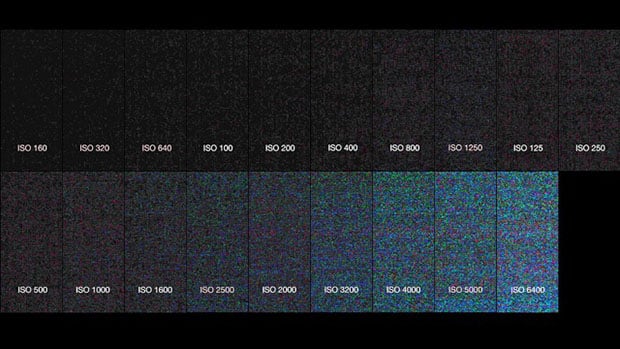
How image noise looks like
Sensitivity (ISO) - on film, it refers to the density of thickness of the strip of film. In a digital medium, it is simply a measurement of the sensor's sensitivity to light. The higher the ISO, the bigger the sensitivity, so ISO will be increased when the amount of light is low. Increasing the ISO, however, results in image noise (granulation), so ideally you want to work with as low an ISO value as possible (ISO 100 is ideal, but not always possible, depending on lighting conditions). For Canon DSLR, it is recommended to use ISO values that are multiples of 160.

Also look up motion blur
Shutter speed (exposure time) - represents the length of time for which the shutter stays open, allowing the sensor to receive light. It is usually represented as fraction of a second. (1/10, 1/25, 0' 5" or 1/2). Obviously, the longer the time, the more light the sensor so for low light conditions you will want to use a longer exposure time. However, for long exposure times both the subject and the camera have to be still (ideally the camera would be on a tripod), otherwise you will get the ghost effect in the photo, or the full bright white areas. If the subject is moving fast, such as athletes at sporting events, then you will want the exposure time to be as short as possible while still getting enough light, so that the picture is crisp and there are no blurred parts. Normally you should keep the exposure time defaulted at 1/25 (which is close to the film camera speed of 24 frames per second - fps) and adjust according to the light conditions.

Depth of field illustrated
Depth of field (focus range) - The focus (not to be confused with focal distance) is defined as the distance from the lens at which a point object produces a point image. While precise focus is only possible at one distance, on each side of the focus plane there will be an area in which the subject will appear to be sharp and focused when viewed at a maximum image resolution. This area is called the depth of field. It varies according to the focal distance and the aperture.The bigger the focal distance, the further away the focus plane will be and the lower the aperture (the higher the f/ value), the bigger the depth of field. If you need a small depth of field (shallow focus), such as for a portrait, you will used a high aperture value (say f/2.8) and shoot from close by. If you need a big depth of field (deep focus), such as for a landscape, you will use a small aperture (f/16, f/22) and a focal length dictated by the distance to the closest object that needs to be in focus.

Aperture values represented
Aperture (focal ratio or t-stop) - it is represented by a number in a logarithmic series preceded by f/ (f/1.2, f/1.4, f/2, f/2.8, f/3.5 .. f/28) and it shows how big the hole through which light gets into the sensor will be. Aperture is probably the most counter-intuitive parameter of the camera and maybe the most important. The higher the f number, the smaller the aperture, so the less light will get into the sensor. This means f/1.2 is the biggest possible aperture, while f/22 means a very small aperture and should only be used in very bright sunny weather. While the crispiest images will be obtained with an aperture of 4-5.6, the value of the aperture used should be determined by the quantity of light available and by the depth of field required. For the aperture greatly influences the depth of field, them being in a reverse proportionality: the higher the aperture, the smaller the depth of field. f/1.2 will have the smallest depth of field, while f/22 will give you a huge depth of field. While I have used here the f/1.2 value, you will notice most prime lenses will have the biggest aperture set at f/2.8, while most zoom lenses have it at f/3.5. Meaning the aperture is a characteristics of the lens, not of the camera. But the point is: the more light, the smaller the aperture, the bigger the f/ value.

Focal length is given as a millimetre value
Focal length (zoom value) - is the distance between the image capturing medium (film or sensor) and the optical centre of the capturing lens. It is a characteristic of the lens, obviously, and on zoom lenses is indicated by its minimum and maximum values. The focal length dictates the field of view angle (the smaller the focal length, the bigger the fov angle) and the distance to the focus plane (the smaller the focal length, the smaller the distance to focus). The human eye has a focal length of about 35-40 mm, so this is the focal length to use if you want a 'realistic' field of view. A low focal length value will give you an optical aberration known as fish eye effect (bending of the edges of the image) which can be more or less obvious depending of the lens. Whenever possible, use prime lenses (an unique focal length) rather than zoom lenses (variable focal length), as they contain less glass and therefore give you more definition. Likewise, try and get closer to the subject rather than using the zoom, as using the lens at its smallest focal length position gives you the greatest control over the image.

The three colour palettes
White balance (K temperature) - is a parameter specific to digital imaging and it is defined as the temperature at which a black object should be heated to give the white colour on camera. This is dictated by your light source and it dictates the colour palette of your image. A low K temperature results in warm, yellow tones, for the naked eye while a high colour temperature results in cold, blue tones. While there are standard values for various light sources (3200K for tungsten lighting, 6400K for HMI lighting and standard outdoors), the white balance will be chosen according to the desired look of the final product. For a natural look you can either experiment with different values or use the AWB setting (auto white balance - this uses the camera specific algorithm to determine the k temperature). For a vivid colour palette (yellow tones), the white balance should be set to a higher value than the one of the light sources, while for a cold, blue, unnatural colour palette, the K temperature should be set to a lower value than the light sources.

These 6 are the most important features of the image, along with the image resolution (number of megapixels), which should always be set to the highest possible. There is a lot more to say about each of them and there are more parameters than this to a digital image. I have tried to cover the basics, although I have also provided links that go into more detail. It is my belief that understanding how these 6 concepts work and how they alter your image will be enough to put one on the path to become a professional photographer.