miercuri, 1 iulie 2015

Second Rome

S.J.A. Turney - The Thief's Tale (The Ottoman Cycle Book One), Victrix Books, 2013

Having finished reading all the 8 books that have come out so far of the Marius' Mules series, I am now learning how it feels for viewers of box sets to wait for a new season. Or, I imagine, for readers of historical fiction waiting for the next book in a series they enjoy. It's frustrating, specially when Simon's last update on it is: "As well as MM8, I'm on various simultaneous projects: I'm in the final stage of editing a kids' book that's with my agent, I'm in the same stage with the joint work with Gordon, I'm busy writing book 2 with Gordon, I've a short story collection for charity sitting idle, waiting for a foreword to finish it off and now I've been signed up to join in with another project."

So my choice of reading was one of Simon's two finished series: The Ottoman Cycle and Tales of the Empire. Given that I am not a big fan of how 'fantasy' sounds' (too reminiscent of Game of Thrones or Lord of the Rings) and I am a new convert of the historical fiction genre, my choice was simple. I was itching to see how Simon portrays the Turks anyway, as the history of the Ottoman Empire is closely related to my country's history, and I'm always curious about that.

This book is almost a case study of how an author is allowed to create his own rules within his own work, as long as they are consistent (unless, of course, he builds inconsistency in as a rule). The book is built on a couple of real historical events and around historical buildings of Istanbul, but the main plot and the main characters are all fictional. Also, so consistently built that a reader can assume the events might as well have taken place. And with this, Simon might give future historians a headache, as once a book that does that reaches classical status it becomes much better at entering the collective memory than a scholastic work. It doesn't even matter that the author himself puts a disclaimer at the end. Some people REALLY believe that Sherlock Holmes REALLY lived at 221b Baker Street and, more important, people like to believe it.

And Skiouros, our hero, is likable enough. He's innocent and mostly open and honest about his intentions, while it's also got plenty of flaws that make it easy for the reader to feel a connection: he's a thief, lowlife, without any ambitions or goals. He's a drifter, basically, though a drifter no older than 24, though likely quite a bit younger than that. And Skiouros story will take him throughout the city of Istanbul where he's spent the last eight years of his life and where, in the space of a week in 1490, the circumstances will take him in close proximity of some of the most powerful men of the day and will transform his life forever. Skiourous' story is fascinating enough, but the way Simon creates situations and twists makes this book a proper thriller, with twists and new developments coming in fast and thick, guaranteed to lose the reader some sleep.

And because Simon is not tied to a real historical narrative, we are completely in the dark, never knowing what's going to happen next. I feared for Skiouros' life quite a few times and the knowledge that the last book of the series is introduced as 'Skiouros returning home' assured me that he'll survive the world-shattering events (in more than one sense) he goes through. Other characters, however, are not that lucky. I was surprised at the sudden brutality with which Simon disposes of some people, it's like he suddenly found his inner George R.R. Martin.

I will throw a spoiler in the mix, so if you're not into that skip this passage entirely. Now, before I get to the next line. Here goes: people are trying to kill the Sultan. Knowing as we do that Bayezid II reigned from 1481 to 1512, we hope we'll be safe in the assumption that the Sultan survives. I did wonder though if, in the virtue of the author creating his own rules principle, Simon might actually pull an Inglorious Basterds on poor Bayezid II. And he's well within his rights to do so, too. Who's to stop him?

I will say this more: the end surprised me quite a bit. This being the Ottoman Cycle, I expected to be introduced to a hero and see life in Istanbul through his eyes over the course of four years. This does not happen and to a reader this unknown course of events and surprising turns are a rich reward. 

If I was to correct anything, I would say Simon is too in love with the historical Istanbul and some pages are going towards talking about that: streets, period colouring, buildings, buildings' interiors, clothing, the looks of food stalls and the like. They're very useful, very educational and provide a sometimes necessary respite, though at times, specially when we know our heroes are in a place of bother, talking about a building's defective staircase is playing on out nerves a bit.

But the one big conclusion to be drawn for this book is that Simon proves he is a multi-faceted writer, able to switch between periods and styles, between the big epic and the individual story while keeping the ingredients that make his books such a good read: the fast-paced action, the suspense, the insane level of documentation.

And sometimes he provides memorable quotes, too. Here's a few samples;

"Haggling with a Greek, they say, is like trying to ride a two-legged donkey: it takes too long and you'll wish you hadn't tried."

"He can see beyond the trappings of their religion to the fact that they are men, and he treats them as such."

"Religious fanatics were dangerous men to work with. They tended toward irrational acts and unpredictable moves."

"Do not worry about tomorrow, for thou knowest not what the day will bring forth" (Judah Ben Sira)

"May God smile upon your ship and your voyages" "And may He look the other way where you're concerned."

sâmbătă, 27 iunie 2015

Backstage

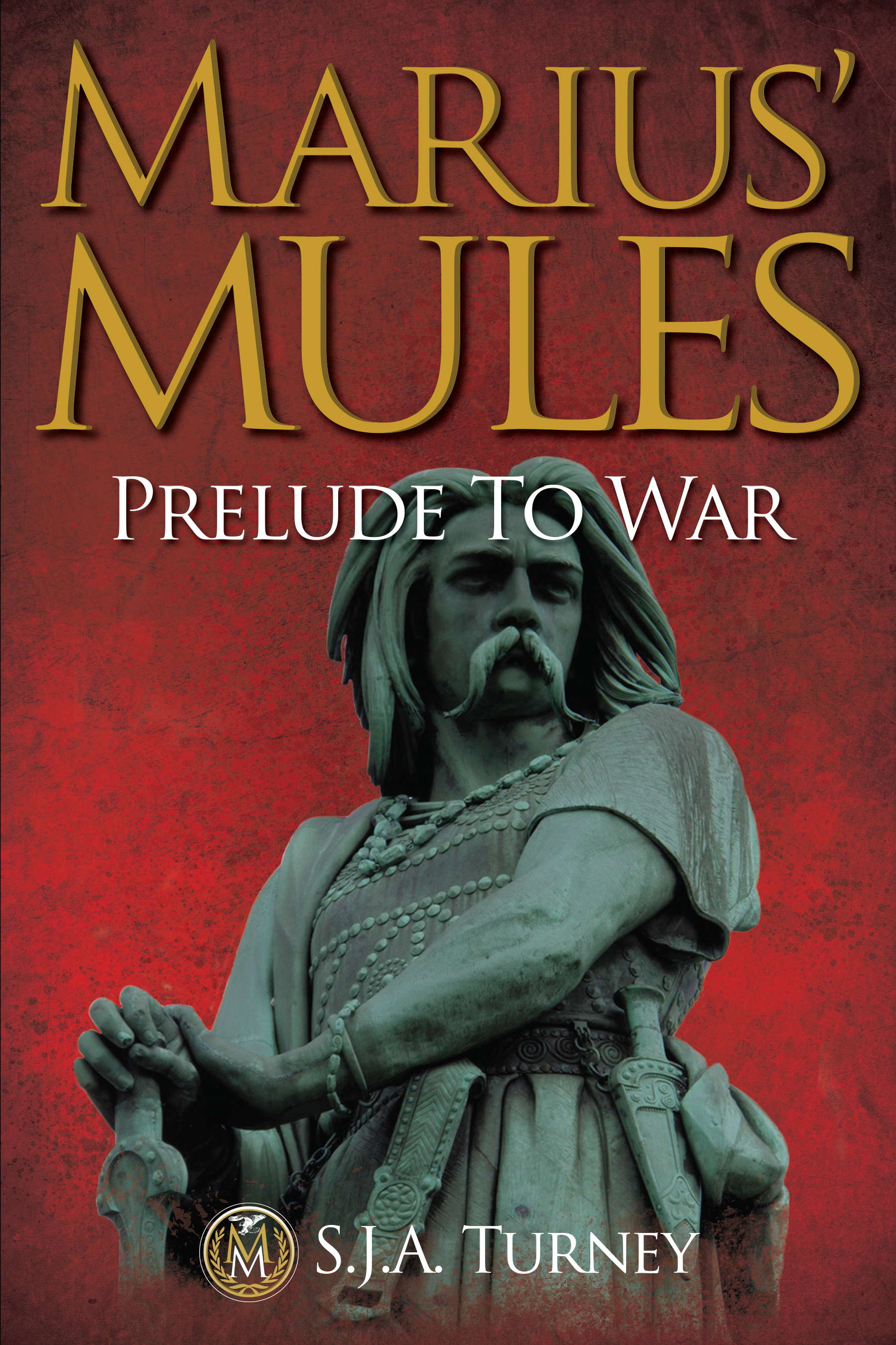
S.J.A. Turney - Prelude to War (Marius' Mules series), Victrix Books, 2014

I'm guessing this volume is born out of Simon's desire to write about important episodes in the great scheme of the Gallic Wars that could not have possibly fit in Caesar's diaries. It might have been a mistake to have stuck so rigidly with the parity between MM books and Caesar's chapters of De Bello Gallico, as for instance this book gives the impression of being the collateral victim of that policy, while MM7 is a monster of a book and in MM8 Simon will have to struggle with a rather uneventful year in Gaul, when Caesar was probably already preparing a confrontation with Pompey.

The fact that it does not have a number assigned makes it easy to overlook, and skipping it as one sails through the series would be a mistake. First, because it's very well written. Nothing unexpected here when it comes to Simon, as he seems to beat his own very high standards with each new release. Faithful readers of the Marius' Mules series will no doubt revel in getting more of the same, while its size would make this book a perfect taster for any new readers. Because maybe with the exception of the very last page, when Fronto's name pops up rather unexpectedly, the stories can very well stand alone.

The second reason not to skip it is that it contains episodes that are very important, if not essential, for the biographies of some of the supporting cast. And by supporting cast, I mean everyone that is neither Fronto nor Caesar. The series gravitates around them, sure, but they are circled by an array of characters, both historical and fictional, that are no less memorable.

In the first story (The Fire Arrow), Cita the quartermaster takes center stage. While only a minor character so far, making him the lead gives us a better understanding of how the behind the scenes of the gleaming Roman legions work, which I suspect is Simon's main purpose for writing this. Plus, it gives us a memorable sidekick, Bennacos of the Boii, a cunning warrior of great ability and even better morals. For some reason it reminded me of Tom Sizemore's character in Saving Private Ryan. The whole story is actually a tale of great heroism, but saying anything more would be giving stuff away, and I encourage people to read it and see for themselves.

No spoilers in the second story, though: Clodius Pulcher dies. While the death of Pulcher and its details are known historical facts, Simon's mastery of the writing craft is in the way he links it with his series and his characters. And I suspect he was itching to write about it, as it is an event with a huge impact on the civil war to follow.

The third story (Rise of Kings) takes us straight back into the heart of the matter: Gaul is very much rising and, while Fronto is nowhere to be seen, Priscus, along with Fabius and Furius, are very much at it, thus giving the feel of being back to the main narrative.

So this is it. For me, Prelude to War was as enjoyable a read as any from the series, and an integral part of it. The only disappointments I can express are that it does not have a number, belittling it somewhat undeservedly, and that it is too short. Not that good literature is exclusive to a certain size, quite the contrary actually. It is just that I found myself at the end of it too quickly. The mark of good writing, after all, is when you can't get enough of it, is it not?

sâmbătă, 6 iunie 2015

The Good Within

Wayne Visser - Sustainable Frontiers, Greenleaf Publishing, Sheffield, 2015

Having just been launched at the beginning of the week, I estimate Wayne Visser's latest book, Sustainable Frontiers, will make quite an impact among the professionals of sustainability. As a matter of fact, judging by the testimonials on its website, it already has.

The book attempts a systemic approach at 'unlocking' sustainability via a series of 8 key factors: leadership, enterprise reform, technology, corporate transparency, stakeholder engagement, social responsibility, integrated value and future fitness. Readers will recognize some of the terms, be intrigued or baffled by others and point out that some of them are better known under a different name. And herein lies one of the problems of sustainability/CSR: no set terminology. It might look like a trivial issue, but allow me to progress the case further of why this is important.

As Dr. Visser repeatedly points out, various forms or elements of sustainability have been around for far longer than our first intuition would make us believe. But there has never been – until recently – a systemic concern for reducing, eliminating or reversing our negative impact; neither have there been enterprises that would have this at their very core, rather than a side concern. As such, the tools for these enterprises are still in development and we are still a way away from knowing how they will end up looking. An important aspect of these tools has to be a set terminology, a commonly agreed lexicon without which the passing of information is rendered extremely difficult, if not impossible. 

Ever since coining the concept of CSR 2.0, one of Dr. Visser's favourite mantras has been that 'CSR has failed'. I tend to disagree with it, or reshape it to 'the CSR model that has been in common use throughout the 90s and the first years of this millennium is outdated'. I'm not even sure this is disagreeing. I think that CSR model (CSR 1.0) has had its uses, that generally corporations are now much more aware of their impact than they were 20 years ago and responsibility has been internalized to some degree by both businesses and society. However, we are still nowhere near a definition of 'CSR' or 'sustainability', though we seem to converge on a few of them.

Another tricky side of this systemic approach is that humans lack any sort of capability of systemic understanding. Daniel Goleman points this out in his book, Focus: The Hidden Driver of Excellence, making the argument that there has never been an evolutionary need for such an understanding. Therefore, putting such an approach in practice is likely out of the grasp of any one individual, though obviously influential individuals can make a stronger push (Muhammad Yunus or Anita Roddick are two examples – both mentioned a number of times as positive influences in sustainability by Dr. Visser).

We are, therefore, caught between over-simplifying what sustainability is (ethical behavior) – this having the disadvantage of raising questions all the time about what exactly is ethical - and this insanely complex approach that throws us into a vast territory over which we have no control. How does a huge corporation know that none of the companies in its supply chain is slipping through the net of ethical business? Is one of the myriads of certifications available out there enough? How do I know that my carefully selected household recyclable waste does not end up in the landfill via some logistical misunderstanding?

The key to this dilemma seems to be collaboration, a set of common goals and growing awareness all across the board on the impact of our own actions. Systems Change is a Multiplayer Game is the title of a sub-chapter in Sustainable Frontiers. The book talks about all of these elements and circumscribes them to CSR 2.0, a new form of acting in both business and society.

As you can very well see, the temptation is – when confronted with some form of theoretical approach to sustainability – to reply to those ideas with my own rather than being able to talk about them. Part of this goes back to the clarity of the lexicon. While it is obvious that most of us, sustainability supporters, are on the same side, ideas need to be clarified before we can fully subscribe to them.

Speaking of sustainability supporters (or superheroes, as Dr. Visser calls them), one of my favourite bits in the book is their classification: experts, facilitators, catalysts and activists. This has been particularly interesting to me as for years I've had an ongoing identity crisis when it comes to sustainability. Not being a professional of the field, but rather a supporter oscillating between elated naivety and fatalistic skepticism, this is helpful in pointing out how you can best serve your goals, whatever angle you approach them from. 

Parts of Sustainable Frontiers have been previously published as newspaper articles. Add to that the fact that the writing style alternates between a corporate report – clear, concise, resorting to facts and figures – and a highly lyrical meditation sprung from the author's own sensibilities – reworded African legends interwoven with meditations on nature and teachings from half-gurus, and it results a book that lacks a certain internal cohesion, that is missing a central narrative. The up side is, we have a very well-structured work, easy to read and to follow and, most importantly, a book whose purpose goes beyond the first lecture, staying as a great companion, guide and ready reference along one's journey through the field of sustainability.

Below are a few quotes that have stood out. Each of them could be the starting point of a separate discussion about what it is and what it would be ideal to be. Those discussions, however, will have to take place some other time.

“If wave after wave of corporate scandals are revealing anything, it is that corporate governance is sometimes not worth the paper it is written on. If the people involved in implementing corporate governance do not have their hearts in the right place and if they are just going through the motions, the process becomes a charade.You can have all the non-executive chairpersons, non-executive directors, board committees and external auditors you like, but things will go hideously wrong if ceremony has replaced substance and cynicism is the order of the day.”

“Impacts that are far away, or in the future, are like smoldering fires in the distance: noteworthy but not action-worthy. People need to feel the heat: directly, personally, here and now. For organisations and leaders, that might mean lighting a few fires.”

“The status quo says that the business of business is to make profits. We have always challenged that. For us, the business of business is to keep the company alive and breathlessly excited, to protect the workforce, to be a force for good in our society and then, after all that, to think of the speculators (shareholders).” (Anita Roddick, The Body Shop)

“Bakan (2004) goes as far as to argue that today's companies are pathological in nature, in the sense that 'the corporation has a legally defined mandate to relentlessly pursue – without exception – its own self interest, regardless of the often harmful consequences it might cause to other' “

“our global economy is so inefficient that less than 1% of all the resources we extract are actually used in products and are still there six months after sale.”

“customers and governments need to give up their compulsive throw-away habits and embrace the take-back economy.”

“Necessity, rather than an unexpected attack of conscience, will be the driving force behind the transition to a circular economy.”

“The problem with the rationalist view of organizing people is that people are not very rational. […] In fact, if our understanding of the current state of psychology is even close to correct, man is the ultimate study in conflict and paradox.”

“The point is that, despite all the evidence and frameworks supporting the notion of the holistic individual, business has yet to respond in a meaningful way. Employees are still regarded by companies as inputs to production and expenses in business rather than creative beings and assets in business. People are still expected to leave their emotions, intuition, dreams, fears, family and community concerns and a myriad other qualities characteristic to being fully human, outside of the workplace. And as workers, they are still expected to be motivated and inspired by monetary incentives, increased productivity and profit making as opposed to personal development, genuine service to others and the search for meaning in their  lives. The time is long overdue for business to begin to serve humans rather than the other way around.”

sâmbătă, 30 mai 2015

Inglorious Singularii (Dirty Contubernia)

S.J.A. Turney - Marius' Mules VI: Caesar's Vow, Victrix Books, 2014

I have finished this book a while ago but I hesitated writing about it because... well because I was under the impression there's not much left to say. I have talked in my previous reviews about how brilliant Simon's books are and how much I enjoy them, and this is always the bottom line. I can only imagine how hard must be for Simon to be keeping writing on the series, and I am always surprised by the energy with which he does it. Because with long series like this you always run into a conundrum: your audience will always want to more about the heroes. They get bored by always being fed more of the same, but at the same time you cannot afford to innovate to much without risking to either making the story too unbelievable or changing the characters so much that they become unrecognizable when compared to their previous selves. That's why a lot of TV series have a dip in quality after two or three seasons.

Having said all that, with this sixth book of the series Simon proves to be a masterful innovator, in that the action develops in a surprising way, while the characters stay true to themselves. At the same time, the historical reality of Caesar's diaries is respected as well, as Simon is very intelligently exploiting a gap in the historical timeline, namely what happened to the rebel king Ambiorix of the Eburones. It is clear that Ambiorix's deed of destroying an entire legion and killing two high ranking officers (Sabinus and Cotta) is the biggest failure of Caesar's Gallic campaigns, with probably heavier losses than even the Battle of Alesia. 

After a bit of a rocky and only partial reconciliation with the general, our hero, Fronto, is given a commando and a mission. This is a turn of events as clever as it is surprising, as it frees Simon to take Fronto and his 20-odd men wherever he pleases. Fans of the series should not be worried, as there is plenty of blood and gore, of hacking and stabbing, though sometimes the numbers are smaller. There are two cult movies this book reminded me of, and they're both referenced in the title. Which makes me rather curious if Simon took any of his inspiration from Tarantino's movie in the same manner in which Inglorious Basterds is inspired by the Lee Marvin classic.

There are a few really great moments in the book, of which one got stuck in my mind due to the depth of the psychological drama: when Fabius has to kill the villagers to whom he promised freedom only moments before, thus going against all his ethical convictions. The army does that to you a lot of the time, and it is captured here surprisingly well.

I need to note a slight disappointment when I think about how fascinated I was about the mythological animals Caesar describes as being part of Northern Gaul's regular fauna and about the longest anthropological inquiry the great man makes into the life of this part of the world in his sixth book of De Bello Gallico. I was eagerly waiting to see what Simon has to say about the weird animal with a horn in the middle of its forehead out of which two pairs of antlers grow. Instead, he dismisses all of it under the label of 'fabulations attempting to mask a military failure'. Which, come to think about it, might very well be true.

So rather than being a mere setup for next year's world-shattering events, this sixth book is actually a great standalone, that can very well be read by itself as well as a natural follow-up to the fifth and the adventures of the previous year. Highly recommended.

Having already read The Great Revolt, I can only say I'm looking forward to reading it again. But before that, Prelude to War, a 'gap-filler'. Very curious.

luni, 25 mai 2015

St. Paul's

Paul McCartney, Out There Tour, 2015-05-24, O2 Arena, London

Unul dintre avantajele unui concert in Londra, spune Paul McCartney, este ca iti poti aduce familia sa te vada. Si mai spune Paul McCartney ca se intreaba ce trebuie sa fie in mintea celor 8 nepoti ai lui, prezenti cu totii la concertul de ieri de la O2, cand stau in sala: "Asta nu e batranelul ala care sta tot timpul intins pe canapea, facand pe bunicul? Wow, e un rock star!"

M-am uitat si eu in seara asta la Paul McCartney si nu mi-a venit sa cred ca batranelul asta e una din cele mai proeminente figuri ale istoriei muzicii, omul care a definit probabil mai mult ca oricine altcineva muzica de azi. Si nu mi-a venit sa cred nu numai ca vad un concert Paul McCartney, dar si ca - vazandu-l pentru a doua oara, dupa Royal Albert Hall in 2012 - stiu la ce sa ma astept.

Arena imensa de la O2, cu acustica ei ciudata si scaunele urcate pana la inaltimi ametitoare face tot posibilul sa diminueze din caldura emanata de muzica de pe scena, dar Paul McCartney a pastrat intacte spiritul, atitudinea, naivitatea si placerea de a canta a anilor '60, cei in care Beatles au schimbat muzica si in buna masura au schimbat lumea. De-asta suna poate altfel astazi Blackbird - melodie compusa din solidaritate cu minoritatea neagra din Statele Unite, si de-asta mi-au dat lacrimile pe Here Today, conversatia cu John Lennon care nu s-a intamplat niciodata. Arata altfel, foarte diferit, lumea de azi fata de cea in care Beatles si-au compus muzica, dar Paul McCartney pare sa fi ramas acelasi.

Melodiile sunt in buna masura reorchestrate, dar asta nu inseamna ca nu sunt la fel de recogniscibile instantaneu. Iar motivul pentru care recunoastem muzica Beatlesilor imediat nu este pentru ca au fost hituri la aparitie - buna parte din audienta din seara asta nu era nascuta cand s-a compus muzica, ci pentru ca muzica Beatlesilor a patruns atat de adanc in fibra societatii incat muzica lor este parte din noi, fie ca o stim sau nu. Mi-e greu sa spun, in contextul asta, cat de privilegiat ma simt ca am avut ocazia sa-l vad si sa-l ascult astazi pe Paul McCartney.

La fel, e greu sa adaugi superlative peste muzica lui Paul McCartney, oricat de uluitor ar fi ca isi pastreaza intacta si atat de evidenta placerea de a fi pe scena si de a canta la mai mult de 50 de ani de cand a devenit superstar.

Majoritatea celor cu sau despre care canta nu mai sunt cu noi. Dus e Mr Marks, cel care a inspirat Temporary Secretary, un synth-pop avangardist si prea putin cunoscut, dusa e Lovely Rita, cea de la care Paul cumpara pui. Demult sunt dusi Eleanor Rigby si Father MacKenzie cu rugaciunea lui, dusi John Lennon si George care a compus Something la ukulele. Dus Frank Sinatra care a spus ca Something e melodia lui preferata de la Lennon/McCartney spre frustrarea amandurora, demult dus Jimmy Hendrix care a invatat Sgt. Pepper's in 36 de ore si il canta la Marquee pe o chitara dezacordata pe care il ruga pe Eric Clapton sa i-o acordeze. Dus si clubul Marquee, inlocuit de Montagu Pyke, un domn cu burta si costum, si dus si posterul din casa lui John Lennon care a inspirat cantecul in beneficiul D-lui Kite. Spectacolul in beneficiul d-lui Kite se va juca insa pentru totdeauna, iar cel pe care l-am vazut in seara asta a fost extraordinar atat prin muzica, cu incarcatura ei emotionala si istorica, dar si imbunatatit incredibil de mult de tehnologie:

Intrarea, cu decorul viu colorat si plin de puncte tipatoare peste care s-a cantat o versiune fidela a lui Eight Days a Week, si-a meritat singura biletul si a reusit sa aduca publicul in atmosfera dupa ceva mai putin de 3 minute, fara nici un fel de trupa de deschidere. Iar urmatoarele vreo 40 de cantece desfasurate pe parcursul a 150 de minute si 3 encore-uri l-au tinut acolo, indiferent ca a fost vorba de clasice ca Yesterday sau Hey Jude, melodii Wings ca celebra Live and Let Die sau compozitii solo ca Maybe I'm Amazed, My Valentine sau cele cateva melodii de pe albumul Art of McCARTney lansat anul trecut.

Se declara uimit ca el, un pusti din Liverpool, a avut ocazia sa cunoasca membri ai guvernului rus si alti asemenea. Ei bine, uimit suntem si eu ca noi, niste murtori de rand, am avut norocul sa-l vedem pe Paul McCartney cantand. Si l-as tot revedea. Macar de opt ori pe saptamana.


vineri, 15 mai 2015

The Roman Shield

A few notes on the design and use of the shield in the Roman Imperial Army following a visit to the Victoria & Albert Museum in London

Simon James Atkinson Turney has lately put his name rather high in the list of my favourite writers. Which led to a strange feeling and an even stranger relationship as Simon, unlike my other favourite writers, is very accessible and very engaging. I think of him, therefore, first and foremost as a social individual and only afterwards an author (I did not say friend as I have only gained this title on facebook, which counts for little).

Simon also does reenactment and sometimes talks about it on his blog. After his most recent Roman adventure I noticed and took particular interest in a picture of his shield. This picture:

I was greatly surprised by the flat wooden grip, as I have always thought the grip of the shield would be the typical two leather straps, one of which goes over the forearm and the second is grabbed by the palm of the left hand. While there is some uncertainty over this, the majority of the researchers and reenacters seem to be convinced this is the grip that was used on the Roman shields. I wasn't. So I went to the closest, most accessible source: Trajan's Column V&A cast. And bam! - here's my proof: 


The two guys in the center of the picture are most certainly Romans (easy to identify by their helmets - with the transverse metal straps reinforcements and the ring at the top - the specially adapted design for the Dacian campaigns). They are also most certainly holding the shield the way I thought they would. It took a while to find them and there are many more instances of the inside of Dacian shields, as the Dacians are on the defensive a lot more. The Dacian shield's grip is identical, but this does not necessarily say anything about the Roman army, unless you count the many occurrences of the two point grip, but even that is circumstantial:


Upon leaving, I noticed something else that would further advance my case: John Deare's Caesar invading Britain (1796):


Pretty obvious, no?


However, Deare's sculpture is useless in this conversation, for a number of reasons: first, it cannot possibly be considered historically accurate, and not only because of the intervening 18 centuries between the events and their depiction. It is highly unlikely Caesar ever looked like Deare depicts him here, or wore clothes that were even remotely similar. Then, remember when I was talking about the innovations of the helmets during the Dacian campaigns? Well, these two helmets are already innovated, almost 2 centuries before. Then we have to consider the influence that medieval weaponry could have had on Deare's conception and questions are hanging around the artist's level of documentation. Furthermore, there is a detail in Deare's pictures that almost blows my case out of the water. Here:


Caesar's grip is also questionable, but how is that guy in the middle holding his shield? And why is his shield square, not round? Or why is he wearing a lorica segmentata, not chain mail like the previous guys? It becomes obvious, no? He is a legionary (heavy infantry), whereas the round shield, chain mail wearing guys are auxiliary (light infantry). Therefore, we have to differentiate between the various bodies of the Roman Army. On the column, we can distinguish three types of Roman shields:

1. The round shield - Celtic in origin and specific to auxiliaries (probably none of them Latin). This has most certainly leather straps for holding in a fight.

2. The square shield - adopted from the Greek hoplites, this is the shield used to create the famous phalanx and the Roman testudos. It is the weapon of the Roman legionaries and the most representative of the Roman shields.

3. The hexagonal shield - as far as I know, this is a typical Roman design, and was used by the Praetorian guard, the elite troops of the army with much less active duty and mostly ceremonial roles.

Far as I could muster, there is no instance of the inside of either a square or a hexagonal shield on Trajan's column. The legions are always in a tidy formation:

This picture reveals little, if anything, about the grip of the shield. Most likely, they are using the wooden handle to hold the shield, but whether there is a leather strap safety or not is hard to say. Straps were apparently used to carry the shield on the march, and it is possible they doubled as a safety hold in the fight.


These guys here seem to have their left hands bent at the elbow, but whether that is accurate depiction or their arms are just badly proportioned is open to debate. The two-dimensional representation is not a big help either.

So this is that. I will keep looking for more details when I get to Bucharest, as the cast of the column there is taken apart and all panels are exhibited at eye level. The conclusion of my visit to the V&A is that while the round, auxiliary shields were held with the arm bent and tied by two leather straps, the likelihood is that legionaries and the praetorian guard held their shields by the wooden handle behind the umbo (the shield boss), arm being kept straight. To me, it seems like this grip is putting a bigger strain on the hand muscles, it offers no insurance in the case of the palm dropping the shield (as opposed to the safety leather strap of the round shield) and takes away entirely the use of the left palm (this is also extremely reduced with the straps, but it is possible to hold another object - be it a pugio or a pilum - while also holding the shield strap). Some of this can be detailed by the reenactors that have actually used one or more types of shields and I am hoping some of them will bring their input.

luni, 6 aprilie 2015

Civil Skirmish

S.J.A. Turney - Marius' Mules V: Hades' Gate, Victrix Books, 2013


With the previous, fourth book of the series, I declared myself disappointed that Fronto is left out of most of the action in the Rhine crossing, and not entirely content with the going ons in Rome while there's a war on we want to read about. This fifth book sees everyone's favourite legate completely out of the action of what it is to my mind another very eventful year in Gaul, yet there's no disappointment in that.

Now immersed in the scenery of the decadence in the great city of Rome, I found it entertaining to read about Fronto's adventures there, of a completely different nature than the ones in rural, barren and manifestly hostile Gaul. It was good to read about a Roman wedding, it was good to see Galba and Rufus in togas and political roles and good to get insights of Pompei in the build up of his oncoming confrontation with Caesar. I have taken a particular liking to Galba ever since the battle of Octodurus - a Roman noble not built for battle or war, but never shying away from either. He is now in the much more familiar environment of Roman politics, but his character and allegiances have stayed intact. A small role for him in the book, but essential for the reader in that it provides the link between the familiar faces of Gallic campaign and the novelty of politics of the city.

Delightful the introduction of Masgava, and I expect the character to become another personal favourite over the next couple of books. I mean, listen to the man: "There is no such thing as pain. It is a fantasy of the weak mind. Do not allow yourself that weakness and you will train yourself to ignore all pain. Be the master of your own body. If you do not, your body will master you and you will be a little more than a bloated sack of organs."

"To be prepared for any fight is mostly a matter of mental attitude rather than skill. See everything around you not for what it is, but for what it could be."

Elijah the Jew is another character I grew fond of very quickly, though I get the impression he is mostly a channel through which Simon voices the respect of his Roman heroes for the monotheistic faith.

Gaul is not forgotten, meanwhile, with Priscus taking over the role of Caesar's prime censor - and a variety of other roles, too. I am still a big fan of Fabius and Furius and their rivalry with Pullo and Vorenus is delightful. I am, however, not entirely sure their characters are thoroughly consistent. Ever since their first appearance they have been deemed untrustworthy by Fronto and pretty much everyone else that matters. After their big reveal moment everyone seems to have taken a particular liking to them and they have turned from the two most uptight centurions in the Roman army into two blokey characters that will probably soon delve onto the same path of booze and indiscipline that Fronto seems to drag everyone to. A long way off from the centurions who'd condemn a man to death for getting a practice exercise wrong. While it is possible - specially given their actions - I think it usually takes a lot longer for people to gain that sort of trust, even more so in a military environment.

Pullo and Vorenus have their big moment in this book, too, (one that I wrongly expected in MMIII), and Simon is at his best when describing it. It would have been an occasion, perhaps,to make more of the competition between them, that goes hand in hand with the camaraderie. Something along the lines of the primus pilus being killed shortly before and the two of them contending for the position - closer to Caesar's description. And it is a great sight to imagine the general watching their mad commando from the ramparts and, encouraged by it, to grow from despair to hope.

For the second invasion of Britain, Simon's approach is rather sympathetic to Cattuvelanus and the Briton tribes. We are dealing with an approach I have seen before, pertaining to Alexander's one day expedition north of the Danube: the great military power was unable to contain the indigenous threat, so they reached a compromise that history has glossed over and they left the invaders with the glory and the natives with the land. Comforting thought, but I doubt reality was ever that way.

Cotta and Sabinus' demise, however, is spot on and exactly how I always imagined it. Also, a very useful subplot that goes to show hostilities did not cease all of a sudden just because legions settled into winter quarters and most of the superior officers went back to families.

Towards the end, this fifth book drops the standard quite a bit. Simon declares the monster of Vipsul one of his great characters. I strongly disagree with it and I find the character rather useless, as is the very vivid torture scene of Balbus' chief slave. Berengarus' plight is a legitimate one and it is easy to understand his quest for revenge. But rather than making it a conversation about the morals of war and their abjection when brought into a civil environment, Simon turns everything into an 80's action movie, with gangs and thugs. The only good thing about it is the moral uncertainty we're left with: Berengarus dies without having his revenge, but is this the way it should have been?

Fronto's reconciliation with Caesar is doubtful, as well. Regardless how powerful, this is a man who endangered Fronto's family and under whose command his physical integrity is never guaranteed. And Fronto has now a lot more to lose. Seems hardly believable he'll leave a young wife and a life in the quiet countryside (where he's also protected from political intrigues) to go back to suffer, fight and endanger his life in an inhospitable and hostile land under the leadership of a man he dislikes.

However, since it's all made up, we need to suspend our belief for a little while. Because yes, the natural course for Fronto would be retirement to an idyllic, patriarchal life style. But that's not much of an action novel, is it?

I'll leave you with a quote that did not seem to fit the body of the review, but is remarkable for its phrasing and its similarity to Sun Tzu's magnificent Art of War: "There are many reasons why a battle is won. Weight of numbers can be a decisive factor, but only if all the other facets are in equal balance. Terrain is often a heavy factor and has ruined many a great commander's day. Morale can be crucial and sees off even supposed conquering armies. And surprise can swing the tide of a fight in a heartbeat."