joi, 29 octombrie 2015

The Play's NOT the Thing

Photograph 51 by Anna Ziegler, 05.09-21.11.2015, Michael Grandage Company, Noel Coward Theatre, London


What I could gather before going to see Nicole Kidman in Photograph 51 was that it is a story of a woman scientist who was robbed of her Nobel prize by people who stole her work, that different people think different things about what actually happened and that the play is not necessarily very true to life.

After seeing the play I'll add to that the bits of biographical information about Rosalind Franklin included in the program and in her short article on Wikipedia. And my take on the facts is this: Rosalind Franklin was a brilliant scientist but not necessarily the most pleasant or easy to deal with of human beings. Being a woman and Jewish is not the most pleasant position to be in in the wake of the Holocaust in a highly competitive, male dominated environment. Add 'sexually repressed' to the aforementioned and we have more than enough for a terrible individual drama. It is a drama consumed entirely in the unseen latency of Rosalind Franklin's personality, in the vast loneliness behind the mask of a hard-ass, impossible to please, annoying bitch. And unfortunately it will continue to have Franklin's psyche as its only host for a while still, as Anna Ziegler chose to approach the subject matter from the perspective of her heroine's scientific career rather than the biographical angle.

The whole play takes place in labs and research centers and the script is laden with scientific terminology which does not render it incomprehensible, but boring at points. I must confess, although I enjoyed the play, I am not the biggest fan of Ziegler's script and I think she made a couple of wrong choices, the first of which I already mentioned. To my mind, Franklin's own demons would have made for a much better story than a picture that has been used without her explicit approval. It would have made more sense, too, as the emotional connection between Ziegler and Franklin hails undoubtedly from both of them being Jewish, women and having to struggle to succeed in environments that aren't necessarily very accommodating.

Perhaps Ziegler was afraid to stray too far from the truth and thus insult the memory of Rosalind Franklin. To this I say a degree of speculation is inherent in any artistic work and as long as the main thesis is in line with the facts, there is no need for all the details to be. In fact, there might be a lot more questionable aspects in the present version of the script than it would have been if the choice was to tell the story of the woman rather than that of the scientist.

The play has a documentary feel - mostly understandable - and the writing is all very factual, the plot hardly ever leaving the lab (except for a passing episode of Franklin (Nicole Kidman) going to see a play which might steam more from playwrights' obsession with self references rather than from some sort of biographical relevance). Franklin's correspondence with Caspar (Patrick Kennedy) is included in the script as is and delivered as monologues. Again, I would have chosen to use a bit more stagecraft, to turn them into dialogues and maybe use them to steer the play one way or the other. Same goes for the (admittedly short) soliloquies of Franklin's assistant Gosling (Joshua Silver) that carry the action forward. Integrating them into dialogue would have enhanced the dramatic feel imho.

And lastly, I do not believe Franklin either cared about or was robbed of the Nobel prize. Hers was a very personal odyssey that hardly lends itself to the understanding of the public. Franklin cared about getting the most accurate experimental results and that's that. Even her approach to the very idea of science is wrong, for science is not the exact description of the facts but rather the best possible explanation of the facts. And fallibility - the possibility of being proven wrong - is a condition sine qua non of scientific theories. And by a shift of paradigm two theories can describe the same set of facts with whole different sets of instruments. Although, in fairness to Franklin, she died before both Kuhn and Popper published their studies on the philosophy of science.

In the way of accuracy of results, Franklin must've died content of her achievements, and rightly so. Which gets me back to the point I've been trying to hammer home - contention does not make for good drama.

Understandably, reviewers are head over heels for Nicole Kidman. Most obviously, hers is a brilliant performance and it is this performance more than anything that gives depth to the character and indeed carries the play forward. But let me just add this: it is an easy part. There is no denying Nicole Kidman is a fabulous actress, but I think this script requires little virtuosity. This is Chopin playing Danny Boy.

I did like the direction and how natural it felt to have all the characters on stage all the time, I liked the sense of separation of spaces, the minimal set changes and in general all the choices Michael Grandage made.

Something good to be said about the set design, too. I thought the cellar full of debris will make little sense before the play, but it is in fact an excellent background for the story, with the additional merit of being historically accurate. The panel lit floor is a great choice too, its effect in the key moment of characters witnessing the DNA model gives the exact sense of wonderment the real scientists must've felt and its effect highly surpasses whatever actual model the designer could've come up with.

I have seen it often on the West End - specially in limited run productions - designers fall too much in love with their sets and then it becomes its own thing. The background comes to the fore, overshadowing the actual play. I was glad it is not the case here. Same goes for music and lights. Both sound and light design are discreet but efficient, just like they should. They underline, emphasize and always support, but never lead. The absolute mark of good production management in my opinion.

And now to the core of the issue that's eating at me: Nicole Kidman as Rosalind Franklin. People who know me also know how much I love Nicole Kidman and how I'd never utter anything bad about her. I do wonder though: would this play have been the sold out run it is if the lead actress had less of a name? Take Nicole Kidman away and you'd struggle to get the script in the most uptight fringe venues in London. I don't like it, but I have accepted it as a fact that star actors is the number one deciding factor in terms of ticket sales. Does it serve the script right, though, to be staged in front of an audience that's there solely to see the lead? And more importantly, does it serve Rosalind Franklin right? Would the quirky, awkward, weird, sexually repressed scientist think her most suitable interpreter is one of the most famous sex symbols of our age? This is in no way a reflection on either of the two women - they're both great just the way they are -  but, if anything, on the audiences, on the general public and on the state of the art consumption.

A very small proportion of this show's public actually cares about Rosalind Franklin as they go in the theatre. If, a hundred minutes later, their interest for the Jewish scientist, for X-ray photography or for the discovery of the DNA double helix structure has increased the least bit then maybe yes, the play is best served by a star actor to top the bill. But has it?

joi, 1 octombrie 2015

Full Circle

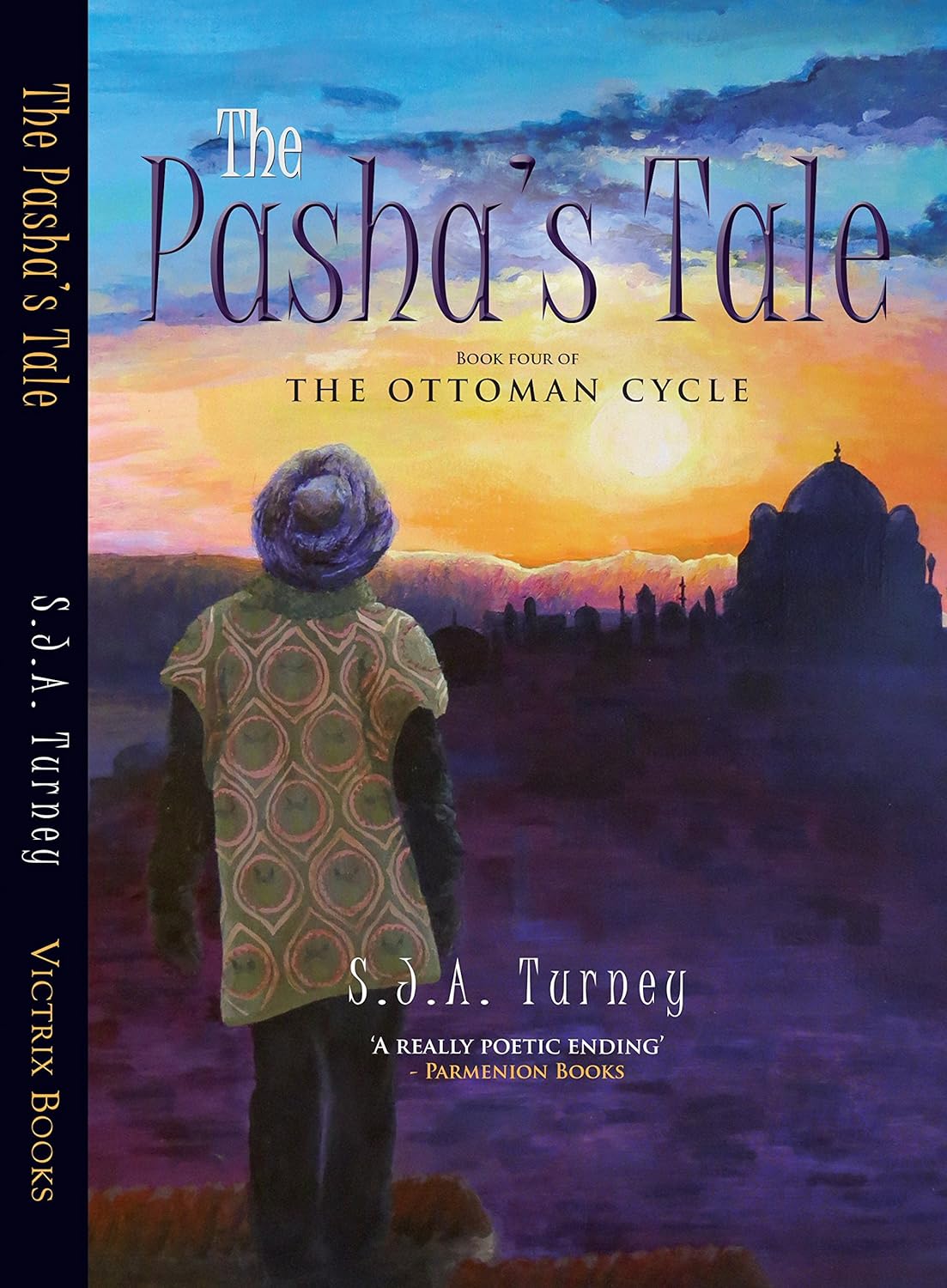
S.J.A. Turney - The Pasha's Tale (The Ottoman Cycle Book Four), Victrix Books, 2015

So this is it. After five years of wandering between the extremities of Mediterranean and beyond, Skiouros is coming back home, Shortest book ever, right? Well... the previous book make no secret about Skiouros intention or destination and it even puts him on a boat. However, even without the promise in the author's note, I knew there's plenty of excitement coming my way. And I was left with plenty of questions: what is home for a kid growing up in occupied Greece, kidnapped and forced to make a living on his own in a foreign metropolis and growing into adulthood mostly on long trips, usually on boats? Is Skiouros going to settle in Istanbul, or is it Hadrianopole his final destination? Is he going to take up farming? Is he going to see his parents again? What of Parmenio the sailor, or Diego, the fugitive master swordsman? And what's the deal with the gypsies anyway? Most importantly, now that the series is ending and he's free of any restraints, is Simon going to actually kill Skiouros? Are we gonna see our hero benefit from a heroic death that gives him a sense of achievement, or is he gonna get an absurd, tarantinesque death?

The book doesn't really start approaching the questions until close to its end, as before we get there Skiouros will be busy with one more adventure. Not really surprising, but this last adventure (or is it?) does not feel artificial or manufactured in any way. There was indeed a point when I said to myself: "Oh, no, not another plot to kill the Sultan!", though I have to admit this is one of the most smartly created plot I've ever read and in some ways it makes even more sense than the previous one.

Diego de Teba is my character of choice in this book and as he was developing he has gained my admiration completely. Not only is he a typical action hero, brilliant with a blade and courageous as hell, but it is indeed his psychological journey that makes him complete. And I'm glad to see Simon venturing so far into a character's psyche, way beyond the territory of a historical action novel.

Otherwise, more description of Istanbul's life and buildings, more about the habits and customs of the Ottoman Empire approaching its peak, interspersed with fight and action scenes so vivid I was sorry the train was closing on to home. I have to say, Seems like all that looking at bricks does pay off.

I have to say, I don't think Simon quite catches the spirit, the very essence of the Ottoman life or of the higher echelons of Ottoman politics, but his books would be not dissimilar to what a Western European (probably a Genovese or Venetian) would describe if they were contemporary with the action.

Now, because I have gone out of my way not to put in spoilers about the Ottoman books, I will wrap it up by giving one that, while it's quite an important pointer, does not really say anything either: Soliman the Magnificent makes a cameo in this book. Curious yet?

On to quotes:

'A man should not seek to discover every angle or every facet of a thing, for by the time he has uncovered the deepest meaning, that thing might be gone. Decisiveness and willingness to act promptly for the good are of prime importance.'

This description of the difference between the drawing desk and the building site has been highlighted by 3 kindle readers, apparently.

'A truly wise man can absorb the principle facts about a thing in a short time, while continued deliberation will only serve to cloud his mind and make him uncertain.'

'One never knows when one might find one's own neck beneath such a blade. Always sweeten the executioner, just in case.'

sâmbătă, 19 septembrie 2015

The Apennine Way

S.J.A. Turney - The Assasin's Tale (The Ottoman Cycle Book Three), Victrix Books, 2014

After taking us from Istanbul to Crete and from there, by land and by sea along the North Coast of Africa to Spain and from there even to the inconceivable beyond, Skiouros' adventures take him to Italy for this third book, where his ultimate foe is alleged to be.

This is of course an opportunity for Simon to talk at large about Italy at the end of the 15th century, and the portrait painted is - not unexpectedly - not entirely complimentary.

By this time our hero, Skiouros the Greek, has formed a solid posse of friends strongly bonded by their former adventures, albeit not by common interest. And if I were to raise an objection to the plot, it would be this: I'm not sure the motivation of the supporting cast is strong enough to take them all along the long and dangerous road they travel over the course of the book.

Parmenio and Nicolo, to whom we've been introduced at the end of the first book, and Cesare Orsini, who we've met in the second book, are joined by a group of other colorful characters of which I wish we could have seen more of. Hopefully this will not spoil the book for you but I will point out that whereas there is a reasonable expectation that not everyone in the cast will make it through their dangerous adventures, the body count in this Assasin's Tale is brutally high, even by Simon's standards.

By the whims of Fortuna, complimented with a drop of his own will this time, Skiouros gets dragged into the highest echelons of the Italian politics of the time and he becomes acquainted with some of the most powerful men in the country. Because the political power and the clerical one are so strongly intertwined this book more than the others not only gives Simon the opportunity, but rather force him to talk at longer length than he's probably comfortable with about religion, divinity, how they are approached and how they should be approached. It's a beneficial venture, as the inquiries into the spiritual do a good job at spicing up what is still a full-on action novel, always exploring siege tactics, fighting techniques and the high end of medieval warfare.

Because of this the book has less of a cinematic feeling, though this does not in any way deny its merits as a fast paced historical adventure novel.

The memorable episode of Skiouros meeting Charles VIII of France is the cherry on the cake of the book, as it epitomises the main purpose of a historical novel: breathing life into characters who'd otherwise only be a picture in a book.

As for the destination of our Greek hero's adventure... talking about it would reveal a great deal of how the action pans out; so instead of doing that, I'll just encourage everyone to discover how exactly Cem Sultan ended his mortal existence. And Simon reveals it in a much more spectacular fashion than Wikipedia will ever be able to.

Because I mentioned a more pregnant presence of divinity in this book than in the others of the series, here's a few quotes to whet your appetite:

Page 7: "God lived in the heart and not in a building, no matter how elegant, and that God listened to the quality of a man's soul, not to the words he uttered by rote from a prayer of any set faith."

Page 137: "God does not approve of vengeful men, though he might oft be so himself"

Page 139: "A dancer in a tin suit is still a dancer, while an ape in breeches is still an ape"

Page 149: "God was a central truth around which men built their own churches to their own needs"

And a very interesting quote on Rome, a hugely important city to Simon's work:

Page 74: "It is a great city full of marvels and glories and hope and beauty [...] but do not let that fool you. It is also a stinking cesspit of whoring, villains, corruption and decay."

This has probably been true for Rome for more than two millennia, as it is true for all metropolis cities throughout history.

vineri, 18 septembrie 2015

Colturi de continent

Totttenham Hotspurs – Qarabag FK 3-1 (Son '28 '30, Lamela '86 – Almeida pen. '6), UEFA Europa League 2016, Grupa J, Joi 18-09-2015, 20:05 GMT, White Hart Lane, Londra

Victorie de rutina pentru Spurs in ciuda unui oponent ambitios si a unei sperieturi initiale

Imi va fi iertat sper faptul ca pana de curand nu auzisem de Qarabag FK. O privire sumara asupra istoriei clubului releva o poveste cu suisuri si coborasuri. Qarabag FK isi joaca meciurile de acasa in Baku, capitala Azerbaijanului, desi echipa este originara din Agdam, un oras de 40.000 de locuitori, complet nimicit de conflictul din Nagorno-Karabakh. Nu prea ramane loc pentru sport in locurile in care razboiul isi face casa. In Agdam, n-a mai ramas loc nici pentru oameni. Dar iata ca, la 20 de ani dupa conflict si la 250 de kilometri de casa, Qarabag a reusit sa inchege o echipa solida cu care domina competitia interna si cu care a speriat in ultimii doi ani nume cu rezonanta in Europa, ca Inter Milano, care n-au reusit sa-i invinga in Baku, sau Celtic Glasgow, care i-a scos la limita, 1-0 in dubla mansa, din calificarile pentru Champions League sezonul asta.

De partea cealalta, Mauricio Pochettino i-a primit pe azeri cu o echipa tanara din care au lipsit piese grele: Ericksen, Bentaleb sau Chadli, in timp ce Harry Kane a fost doar rezerva.

Tottenham incep meciul relaxati, prea relaxati poate, iar oaspetii vor sa demonstreze ca nu se sperie de numele adversarilor lor. Asa ca primul sut pe poarta apartine azerilor, iar Lloris trebuie sa se intinda serios pentru a preveni un gol dupa doar doua minute de joc. Primul gol va veni insa repede, 5 minute mai tarziu, cand Richard Alemida transforma o lovitura de pedeapsa acordata in urma unui fault al lui Wimmer.

Chiar si conducand, azerii continua sa joace pozitiv si desi cedeaza posesia, se apara exact si contrataca rapid, reusind un al doilea sut pe poarta in minutul 20, inainte ca Spurs sa-l solicite in vreun fel pe portarul Sehic. Dar cand il vor solicita, va fi doar sa scoata mingea din plasa, pentru ca apararea lui Qarabag nu stie cum sa raspunda unei presiuni crescande a gazdelor. Sud coreeanul Son, recent achizitionat de la Leverkusen, profita de doua mari greseli defensive pentru a-si trece in cont o dubla in mai putin de 3 minute.

La 2-1 gazdele revin la carma jocului si intetesc presiunea la poarta lui Sehic, dar Alli rateaza din pozitie de 1 la 1 cu portarul sansa de a inchide meciul. Qarabag reuseste doua contraatacuri periculoase, dar scorul ramane neschimbat pana la pauza.

Tottenham iese de la cabine mult mai proaspata iar in repriza a doua azerii vor fi complet dominati fizic si sunt norocosi ca nici una din ocaziile lui Spurs din debutul reprizei nu se concretizeaza. Lamela in special e teribil de ghinionist sa nu inscrie in minutul 52, cand sutul lui il depaseste pe portar, dar loveste bara si iese in afara terenului. Francezul va trebui sa astepte pana cu 5 minute inainte de final pentru a-si trece numele pe tabela.

In minutul 86, dupa o pasa a lui Harry Kane, introdus in minutul 67 in locul lui Son, Lamela il lobeaza pe Sehic si duce scorul la 3-1, rezultat ce se mentine pana la final.


Victorie meritata a gazdelor, dar fotbalistii lui Qarabag trebuie felicitati pentru fotbalul pozitiv practicat si pentru increderea cu care joaca in fata unor adversari mult mai bine cotati. Doar naivitatea, lipsa de experienta si conditia fizica superioara a englezilor le-au adus in final o victorie comfortabila. Dar rezultatul nu spune toata povestea, a fost un meci frumos si ambele echipe au contribuit cu ocazii si faze de poarta. Daca isi mentin filozofia de joc, e foarte probabil ca azerii sa incurce socotelile calificarii in aceasta grupa complicata, din care mai fac parte Anderlecht si Monaco.

sâmbătă, 1 august 2015

Secera si ciocanarii

West Ham United – Astra Giurgiu 2-2 (Valencia '23, Zarate '51 – Boldrin '71, Ogbonna '82 og), UEFA Europa League 2016, Turul 3 preliminar, prima mansa, Joi 30-07-2015, 7:45 GMT, Boleyn Ground Londra, Spectatori: 33.858

O ocazie importanta pentru doua echipe ce se intalnesc rar cu cupele europene, jucata intr-o atmosfera de presezon

Vedere de la masa presei
Cadorisita de UEFA cu un loc in Europa League datorita castigarii titlului de cea mai fair-play echipa din Anglia sezonul trecut, West Ham United este, cel putin la nivel declarativ, un club nerabdator sa-si rasplateasca suporterii cu un parcurs european bun in ultimul sezon petrecut pe Boleyn Ground. Realitatea este insa putin diferita intrucat ciocanarii au trecut cu greu in turul doi al calificarilor de modesta echipa malteza FC Birkirkara, avand nevoie de prelungiri si lovituri de departajare, iar in meciul din aceasta seara au aratat ca o echipa neinchegata, nerodata si nepregatita pentru noul sezon care deja a inceput.

De celalta parte, Astra Giurgiu – un club fara multa experienta europeana, in ciuda unui parcurs decent in sezonul trecut – nu avea decat de castigat din aceasta excursie la Londra, un meci impotriva unei din Premier League insemnand mult pentru elevii lui Marius Sumudica.

Ciocanarii plecau asadar ca favoriti, si au inceput meciul onorandu-si statutul, cu o asezare mai buna in teren si mult mai multa siguranta in posesia mingii. Desi fara sa fie excesiv de spectaculoasa, prima parte a meciului a apartinut gazdelor, care s-au multumit sa preseze steril, sa-si impinga adversarii pe linia de 16 si sa inabuse rapid orice contraatac. Planul a parut sa functioneze, in parte si datorita unui inceput timorat al oaspetilor. Marius Sumudica avea de altfel sa recunoasca dupa meci ca elevii lui au jucat cu frica initial, cedand posesia si multumindu-se sa absoarba atacurile londonezilor.

Perioada de presiune a gazdelor a dat roade dupa 20 de minute de joc, iar Enner Valencia a deschis scorul in urma unei serii de cornere in succesiune rapida acordate de Astra in partea dreapta a apararii. West Ham au avut astfel ocazia sa puna in practica schemele exersate la antrenament pana cand au gasit formula castigatoare: pasa scurta in lateral, o minge aruncata inalt in careul Astrei pe care Valencia, inaltat cu un cap peste marcatorul lui direct, a trimis-o in plasa.

Ciocanarii vor mai avea doua mari ocazii pana la pauza, doar paradele lui Silviu Lung reusind sa mentina scorul la 1-0. Raspunsul echipei noastre a fost timid, primul sut pe poarta al giurgiuvenilor fiind inregistrat in minutele de prelungire ale primei reprize prin Amorim, care a incercat sa-l surprinda pe Adrian de la aproximativ 20 de metri.

Pauza le-a gasit pe gazde cu un avantaj minim, dar Bilic a fost nevoit sa faca doua schimbari in prima repriza, amanunt cu repercusiuni pentru rezultatul final: Valencia, accidentat, a fost inlocuit de Modibo Maiga in minutul 37, la doar 3 minute dupa ce Reece Burke i-a luat locul lui Joey O'Brien in partea dreapta a apararii, acolo unde antrenorul croat a sesizat un potential punct nevralgic.

Repriza a doua a inceput in aceeasi maniera ca si prima, cu gazdele in atac, Zarate reusind sa dubleze avantajul echipei sale dupa doar 5 minute de la reluarea jocului. O tasnire din banda dreapta, trei adversari depasiti si un sut de la marginea careului printre cei doi fundasi centrali ai Astrei au reusit sa-l invinga pe Silviu Lung si sa rasplateasca frumosul efort al argentinianului cu un gol ce parea sa incline balanta calificarii decisiv in favoarea gazdelor.
Astra a parut insa sa se trezeasca usor-usor si sa atace ceva mai curajos, dar doua greseli individuale ale experimentatului fundas James Collins vor fi cele care vor relansa meciul: mai intai Collins primeste cartonas galben pentru un fault de o duritate excesiva asupra lui Budescu pentru ca doar 3 minute mai tarziu acelasi duel sa se repete la o faza la care Budescu ar fi scapat in situatie de unu la unu cu portarul. Collins e nevoit sa faulteze din nou atacandu-l pe jucatorul roman din spate. Chiar daca acceptam opinia lui Bilic cum ca eliminarea e putin cam dura, al doilea cartonas galben e justificat iar Collins nu ar fi trebuit sa se puna intr-o asemenea situatie.

Aflati de odata in fata unui adversar in inferioritate numerica, giurgiuvenii prind brusc curaj si vor avea nevoie de doar 5 minute pentru a crea prima mare ocazie, in minutul 63 Reece Oxford vazandu-se obligat sa respinga mingea de pe linia portii.

Usor-usor Astra pune stapanire pe joc si un sut de la aproximativ 25 de metri al lui Fernando Boldrin va prinde interiorul transversalei, de unde ricoseaza in plasa, facand inutila parada lui Adrian.

Cu un moral complet schimbat dupa 2-1, romanii continua sa atace din ce in ce mai curajos si sa isi creeze o serie de situatii bune. Cel care va inscrie insa va fi un jucator al gazdelor, noua achizitie Ogbonna – fundasul central cumparat de la Juventus pentru 11 milioane de euro – deviind in proprie poarta o centrare a dracilor negri care nu promitea foarte multe.

La 2-2 si cu ceva mai putin de 10 minute de joc ciocanarii reiau atacurile la poarta lui Lung de aceasta data insa fara luciditatea din debutul partidei, ci mai degraba cu o frustrare rezultata din constientizarea faptului ca acest scor da prima sansa de calificare echipei romanesti.

Desi impinsi inspre propria poarta de catre agresivitatea gazdelor, baietii lui Sumudica reusesc sa reziste si chiar vor incerca sa contraatace timid, dar singurele evenimente notabile pana la sfarsitul partidei vor fi cartonasul galben primit de Dimitri Payet pentru proteste si trimiterea in tribuna a antrenorului croat Slaven Bilic de catre centralul partidei.

Desi nimic nu e inca decis, acest 2-2 da prima sansa romanilor, carora un 0-0 la Giurgiu le va fi suficient pentru a trece mai departe.

Marius Sumudica a incercat in conferinta de presa de dupa meci sa discrediteze sansele echipei sale, insistand ca West Ham sunt in continuare favoriti la calificare, accentuand diferenta de valoare de piata si de valoare individuala in favoarea englezilor cat si superioritatea fizica a acestora.

Abordarea managerului lui West Ham a fost insa mult mai pesimista, Slaven Bilic afirmand ca fara Tomkins, Diafra Sakho si Collins (eliminati) si fara Enner Valencia (accidentat), misiunea europeana a baietilor lui este mult mai dificila acum decat inaintea celor 90 de minute de joc. In acelasi timp, antrenorul croat a parut preocupat mai putin de un parcurs european si mai mult de debutul Premier League in care echipa lui ii va primi pe acelasi stadion pe mult mai bine cotatii vecini din nordul Londrei, Arsenal.

Ca o concluzie, meciul din seara aceasta a fost unul destul de spectaculos, cu patru goluri si un nivel de fotbal decent, chiar daca a fost evident ca nici una din cele doua echipe nu e inca pusa complet la punct cu pregatirea pentru noul sezon.

Astra Giurgiu a obtinut un rezultat foarte bun dintr-o deplasare extrem de grea si are acum prima sansa la calificarea dupa aceasta dubla. Elevii lui Sumudica s-au prezentat onorabil si par a constitui un grup suficient de bine inchegat pentru a se reprezenta cu demnitate in Europa.


In acelasi timp, West Ham United nu pare o echipa suficient de inchegata incat sa abordeze noul sezon cu prea mare incredere. Cu o serie de achizitii noi, din care nici una extrem de spectaculoasa, ciocanarii par a avea nevoie de mai mult timp atat pentru a crea relatiile de joc care sa fluidizeze curgerea mingii cat si pentru a se adapta stilului ofensiv si spectaculos pe care Slaven Bilic incearca sa-l impuna, mai ales ca Sam Allardyce, fostul antrenor, este un pragmatic desavarsit, adeptul declarat al rezultatului cu orice pret si al ideii ca scopul este mai important decat metoda. Ar trebui sa fie un sezon istoric pentru ciocanari, care isi vor parasi casa de 100 de ani la vara – legendarul Boleyn Ground – in favoarea stadionului olimpic aflat la aproximativ 3 kilometri distanta si cu o capacitate de peste doua ori mai mare. Aceasta extindere este abil exploatata de o politica de marketing foarte inteligenta si este menita sa creasca veniturile londonezilor si sa-i plaseze in aceeasi categorie cu echipele de top ale Premier League. Dar daca managementul inteligent nu e dublat de rezultate bune in teren, sezonul ciocanarilor risca sa se transforme intr-un fiasco.

marți, 14 iulie 2015

Pirates of the Mediterranean

S.J.A. Turney - The Priest's Tale (The Ottoman Cycle Book Two), Victrix Books, 2013

When I started reading The Ottoman Cycle I imagined, in my immense naivety, that the action will take place on the background of the new Istanbul, making the series an immense fresco of the city and the time. While this is certainly true for the first book, The Priest's Tale sees our hero, Skiouros, away from the capital of the empire, on an adventure that starts is Crete and ends... very far away from it. Saying the end is unexpected is an understatement, but I'll try not to give anything away as potential readers might want to discover where it ends for themselves. But the richest of the rewards in this book, like a lot of the times, lays a lot more with the journey than with the destination.

Skiouros goes half-circle around the Mediterranean, by sea and by land, and encounters trouble wherever, without particularly looking for it. The end of the previous book has introduced us to two characters, captain Parmenio and Nicolo, but gave no clue as to how important they will become in the story. Together with a rather mysterious Italian nobleman they will form Skiouros' posse, an adventurous gang of friends that makes the novel smell like bromance at times, another innovation to what was largely an individual story in the first book.

The Mediterranean world in the late 15th century is a very interesting place, a mixture of civilizations that clash, collide, live side by side and influence each other over a flurry of material for the interested historians and anthropologists. And we encounter all of these civilizations here: the Ottoman Turks who took over the ruins of Byzantium, the shrinking Arab world of North Africa, the Berber nomads roaming free across the ruins of the Phoenician empire, the Egypt of Mamluks and the warring Catholic states of Western Europe. And like all Simon's books, real history goes closely along the personal stories, making his books a history lesson delivered in the form of an action novel. Which is the ideal recipe for children books, really, the structure of most books I grew up with.

Religion being the important social element that it is in this era, is an unavoidable aspect as Skiouros' story too. And in this an author cannot but betray his own beliefs, siding automatically and unconsciously with whatever faith is closer to his convictions. There is no secret that Simon's values are mostly secular ones and as such , the more pervasive a certain faith will be, the less virtuous it will be deemed. To that end, the biggest villain in the book is the most fanatical believer: Etci Hassan, the Ottoman pirate, is by far the best villain in any of Simon's books I read so far and an all-round great villain by any measure. It does have an element of Jafar and it does echo of the Islamic fanaticism of which we see far too much today, but this Turkish pirate is a man of his age and it made me understand better how the interest of the Italian city-states at sea have collided with the Ottoman ones and led to the great naval battle of Lepanto.

Speaking of Hassan's vengeful quest, I did wonder at times if his resolve could not have been put to better use, if his chase of a Greek fugitive is not too insignificant a goal for a commander of the Ottoman fleet. And this is one point in which maybe the reader is required to suspend his belief here and there: is Skiouros' quest really worth it? Is his ultimate target really that guilty for the crime he is chased for to be deserving of that much hateful determination? And could his friends not divert him to better causes rather than getting whirled in this personal story of revenge?

And Skiouros does seem to be more and more of a conflicted character and this development does make for a better book, though the inflexibility of his ultimate goals bring some predictability that might not be necessary.

Two great pluses to compensate for this slight drawback: first, this is an action novel. The twists and turns, the fights and chases come thick and fast and I usually found it hard to put the book down as I would want to see which way an action scene is gonna go; only for it to be followed by another action scene and before you know it, the hours have flown by.

The second plus is a gallery of secondary characters, of which I would have liked to see more of: Don Diego de Teba, a Zorro avant-la-lettre, the fighting priest in Tunis, the gypsy traveler, Kemal Reis, the good Muslim and most of all, the Caravan lady, an absolutely delightful character that unfortunately disappears from the story way too quickly for my liking.

I will end my review with a quote that is becoming recurrent, as it appears at least twice in the third book of the cycle as well: "Vengeance is hollow victory, and as oft destroys its perpetrator as its target", Cesare Orsini tells Skiouros, and in the light of this wise words I am very curious to see if and how the young Greek's vengeance will be carried to an end. I am a book and a half away.

miercuri, 1 iulie 2015

Second Rome

S.J.A. Turney - The Thief's Tale (The Ottoman Cycle Book One), Victrix Books, 2013

Having finished reading all the 8 books that have come out so far of the Marius' Mules series, I am now learning how it feels for viewers of box sets to wait for a new season. Or, I imagine, for readers of historical fiction waiting for the next book in a series they enjoy. It's frustrating, specially when Simon's last update on it is: "As well as MM8, I'm on various simultaneous projects: I'm in the final stage of editing a kids' book that's with my agent, I'm in the same stage with the joint work with Gordon, I'm busy writing book 2 with Gordon, I've a short story collection for charity sitting idle, waiting for a foreword to finish it off and now I've been signed up to join in with another project."

So my choice of reading was one of Simon's two finished series: The Ottoman Cycle and Tales of the Empire. Given that I am not a big fan of how 'fantasy' sounds' (too reminiscent of Game of Thrones or Lord of the Rings) and I am a new convert of the historical fiction genre, my choice was simple. I was itching to see how Simon portrays the Turks anyway, as the history of the Ottoman Empire is closely related to my country's history, and I'm always curious about that.

This book is almost a case study of how an author is allowed to create his own rules within his own work, as long as they are consistent (unless, of course, he builds inconsistency in as a rule). The book is built on a couple of real historical events and around historical buildings of Istanbul, but the main plot and the main characters are all fictional. Also, so consistently built that a reader can assume the events might as well have taken place. And with this, Simon might give future historians a headache, as once a book that does that reaches classical status it becomes much better at entering the collective memory than a scholastic work. It doesn't even matter that the author himself puts a disclaimer at the end. Some people REALLY believe that Sherlock Holmes REALLY lived at 221b Baker Street and, more important, people like to believe it.

And Skiouros, our hero, is likable enough. He's innocent and mostly open and honest about his intentions, while it's also got plenty of flaws that make it easy for the reader to feel a connection: he's a thief, lowlife, without any ambitions or goals. He's a drifter, basically, though a drifter no older than 24, though likely quite a bit younger than that. And Skiouros story will take him throughout the city of Istanbul where he's spent the last eight years of his life and where, in the space of a week in 1490, the circumstances will take him in close proximity of some of the most powerful men of the day and will transform his life forever. Skiourous' story is fascinating enough, but the way Simon creates situations and twists makes this book a proper thriller, with twists and new developments coming in fast and thick, guaranteed to lose the reader some sleep.

And because Simon is not tied to a real historical narrative, we are completely in the dark, never knowing what's going to happen next. I feared for Skiouros' life quite a few times and the knowledge that the last book of the series is introduced as 'Skiouros returning home' assured me that he'll survive the world-shattering events (in more than one sense) he goes through. Other characters, however, are not that lucky. I was surprised at the sudden brutality with which Simon disposes of some people, it's like he suddenly found his inner George R.R. Martin.

I will throw a spoiler in the mix, so if you're not into that skip this passage entirely. Now, before I get to the next line. Here goes: people are trying to kill the Sultan. Knowing as we do that Bayezid II reigned from 1481 to 1512, we hope we'll be safe in the assumption that the Sultan survives. I did wonder though if, in the virtue of the author creating his own rules principle, Simon might actually pull an Inglorious Basterds on poor Bayezid II. And he's well within his rights to do so, too. Who's to stop him?

I will say this more: the end surprised me quite a bit. This being the Ottoman Cycle, I expected to be introduced to a hero and see life in Istanbul through his eyes over the course of four years. This does not happen and to a reader this unknown course of events and surprising turns are a rich reward. 

If I was to correct anything, I would say Simon is too in love with the historical Istanbul and some pages are going towards talking about that: streets, period colouring, buildings, buildings' interiors, clothing, the looks of food stalls and the like. They're very useful, very educational and provide a sometimes necessary respite, though at times, specially when we know our heroes are in a place of bother, talking about a building's defective staircase is playing on out nerves a bit.

But the one big conclusion to be drawn for this book is that Simon proves he is a multi-faceted writer, able to switch between periods and styles, between the big epic and the individual story while keeping the ingredients that make his books such a good read: the fast-paced action, the suspense, the insane level of documentation.

And sometimes he provides memorable quotes, too. Here's a few samples;

"Haggling with a Greek, they say, is like trying to ride a two-legged donkey: it takes too long and you'll wish you hadn't tried."

"He can see beyond the trappings of their religion to the fact that they are men, and he treats them as such."

"Religious fanatics were dangerous men to work with. They tended toward irrational acts and unpredictable moves."

"Do not worry about tomorrow, for thou knowest not what the day will bring forth" (Judah Ben Sira)

"May God smile upon your ship and your voyages" "And may He look the other way where you're concerned."